

Boxing Heavy Bag Workout
Few training tools in boxing have stood the test of time like the heavy bag. From professional fighters preparing for championship bouts to beginners stepping into the gym for the first time, the boxing heavy bag workout remains one of the most effective ways to develop power, endurance, and technical precision.
At Spartans Boxing Club, coaches view heavy bag training as more than simply hitting a target. It represents a structured training method that combines conditioning, coordination, and discipline. Each round on the bag simulates elements of a real boxing match, helping athletes build both physical and mental resilience.
A properly structured session can burn between 300 and 500 calories while improving footwork, timing, and overall boxing fitness training capacity.
This article breaks down the complete system behind effective heavy bag training, starting with fundamentals and gradually building toward advanced methods used by experienced boxers.
Why the Heavy Bag Is Essential in Boxing Training
Heavy bag sessions sit at the center of nearly every boxing workout routine because they offer something other training tools cannot: resistance with realism. When punches land on the bag, the athlete experiences feedback similar to striking an opponent, allowing technique and power to develop naturally.
Unlike shadowboxing or pad work, the heavy bag also forces the body to generate force through proper mechanics. This strengthens the entire kinetic chain, from the feet driving the movement to the rotation of the hips and shoulders that deliver each punch.
Another benefit is its versatility. A punching bag workout can be adapted for different goals:
- Building explosive punching power
- Improving cardiovascular endurance
- Refining combination techniques
Because the bag moves after impact, athletes also learn to control distance and rhythm, two skills that separate experienced boxers from beginners.
How Heavy Bag Training Improves Boxing Performance
Building Punching Power
One of the primary advantages of heavy bag boxing training is its ability to develop genuine punching strength. Every strike requires the boxer to transfer energy through the legs, hips, and torso before it reaches the fist.
When this movement pattern is repeated over multiple rounds, the body becomes more efficient at generating force. Over time, punches become faster and heavier without requiring excessive effort.
Power also comes from correct body alignment. Coaches often emphasize rotating the hips and pivoting the feet while striking. These subtle mechanics transform a basic jab or cross into a powerful scoring punch.
Developing Cardio and Endurance
Boxing is often described as one of the most demanding combat sports, and heavy bag sessions are a major reason why. Each round pushes the heart rate into a high-performance training zone, making it a highly effective boxing cardio workout.
Short bursts of punches followed by brief rest intervals mimic the intensity patterns seen in professional fights. This structure trains the cardiovascular system to recover quickly between exchanges.
Research from organizations such as the American Council on Exercise highlights boxing training as a powerful method for improving cardiovascular health while also enhancing coordination and balance.
Improving Coordination and Timing
The heavy bag is also an excellent tool for sharpening reaction speed. As the bag swings after each strike, the boxer must adjust positioning and timing.
This dynamic movement teaches fighters to anticipate targets and maintain rhythm, which becomes essential when sparring or competing. Over time, the body learns to link punches into fluid combinations rather than isolated strikes.
Understanding the Structure of a Heavy Bag Session
The Round-Based Training System
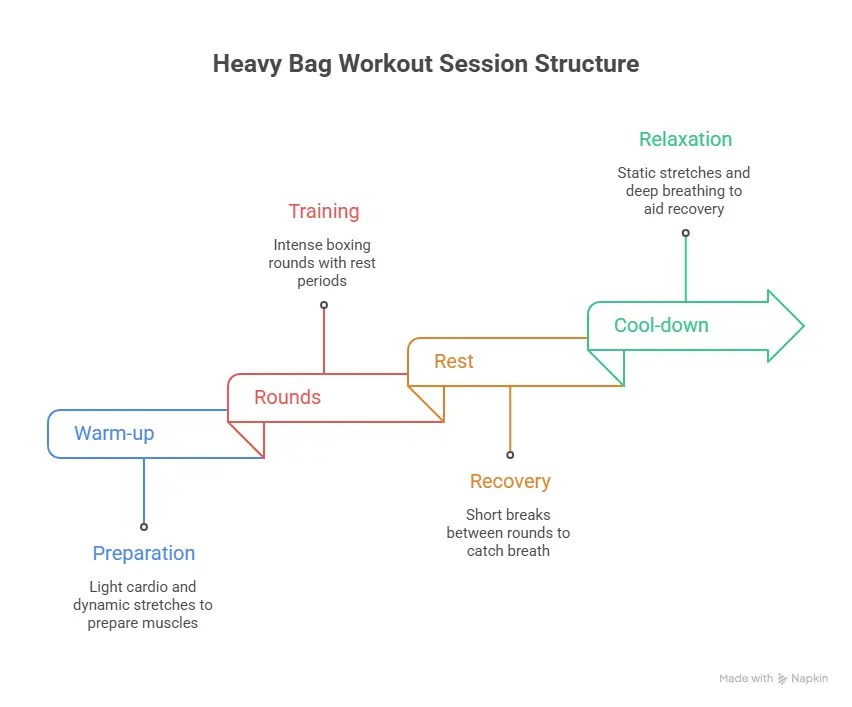
Most boxing heavy bag workout sessions follow the same format used in competitive boxing: timed rounds separated by short recovery periods.
Beginners usually start with two-minute rounds before progressing to three-minute rounds, the standard used in professional bouts. This structure allows athletes to train intensity while still maintaining proper form.
A typical training format might include four to six rounds focused on technique and conditioning.
Why Round Training Works
Round-based training creates urgency and discipline. Knowing the clock is running forces athletes to maintain focus, while rest intervals provide just enough recovery to sustain performance.
This pattern closely mirrors how real boxing matches unfold, helping the body adapt to the rhythm of competition.
Preparing for Your First Heavy Bag Workout
Warming Up Before Hitting the Bag
A proper warm-up prepares the muscles and joints for impact. Skipping this step increases the risk of wrist or shoulder injuries, especially for beginners.
Most coaches recommend five to ten minutes of light movement before starting heavy bag drills. Activities such as shadowboxing or skipping rope gradually increase heart rate while activating key muscle groups used in punching.
Essential Equipment for Safe Training
Before starting a boxing heavy bag workout, athletes should ensure they have the right gear. Hand protection is particularly important because repetitive impact can strain joints and tendons.
At Spartans Boxing Club, beginners are typically introduced to three basic items:
- Boxing gloves to cushion impact and protect the knuckles
- Hand wraps to stabilize the wrist and support small bones in the hand
- A properly mounted heavy bag that absorbs force safely
These pieces of equipment work together to prevent injury while allowing the athlete to train with confidence.
Beginner Boxing Training on the Heavy Bag
Starting With Simple Combinations
For beginners, heavy bag training begins with mastering fundamental punches rather than throwing complex combinations immediately. Basic strikes create the foundation for all future techniques.
The first combination most athletes learn is the jab-cross sequence, often referred to as the “1–2.” This pairing introduces both lead-hand accuracy and rear-hand power.
Once that movement becomes comfortable, additional punches such as hooks and uppercuts can be added to create more advanced combinations.
Controlling Power and Accuracy
Many beginners assume that hitting the bag harder automatically leads to better results. In reality, experienced coaches encourage new athletes to start at around 50–75 percent power.
This approach allows fighters to focus on accuracy, body alignment, and breathing patterns. Power can always be added later once technique becomes consistent.
Practicing controlled strikes also prevents the bag from swinging excessively, which helps maintain rhythm during combinations.
Developing a Full Body Boxing Workout
One reason heavy bag training is so effective is that it engages nearly every muscle group in the body. While the punches appear to come from the arms, the movement actually begins in the lower body.
Footwork initiates momentum, the core transfers energy, and the shoulders guide the final direction of the strike. This coordinated motion transforms the session into a highly effective full body boxing workout.
Over multiple rounds, athletes experience improvements in strength, endurance, and coordination simultaneously. The result is a training system that builds both athletic performance and overall fitness.
How Heavy Bag Training Builds Boxing Power and Endurance
As athletes progress beyond beginner drills, heavy bag workouts begin to emphasize boxing power and endurance. Longer combinations, faster punch rates, and increased movement around the bag push the body into higher performance zones.
These sessions often incorporate elements of boxing conditioning drills, where fighters alternate between explosive combinations and defensive footwork.
The goal is not just to hit harder but to sustain effective technique even under fatigue. This ability becomes crucial during sparring sessions and competitive bouts.
The Role of Technique in Heavy Bag Training
While conditioning is an important benefit, the heavy bag is ultimately a tool for refining boxing technique training. Every punch thrown against the bag provides immediate feedback.
If the strike lands correctly, the bag moves cleanly. If the technique is flawed, the punch feels awkward or off-balance.
This feedback loop allows athletes to adjust their stance, guard position, and rotation mechanics. Over time, these corrections become automatic.
Experienced trainers also encourage fighters to circle the bag while punching rather than standing still. This movement mimics real fight scenarios and improves spatial awareness.
Transition to Intermediate Heavy Bag Training
Once beginners become comfortable with basic combinations and round timing, their training begins to evolve. The focus shifts from simply hitting the bag to controlling rhythm, movement, and strategy.
Intermediate workouts introduce faster punch sequences, defensive movements, and varied attack angles. These elements prepare athletes for more complex boxing workout routines that challenge both skill and endurance.
Structuring an Effective Heavy Bag Training Session
After mastering the fundamentals, athletes begin to approach the boxing heavy bag workout with greater structure and purpose. Instead of simply throwing punches, each round is designed to focus on a specific goal such as technique refinement, conditioning, or combination building.
At Spartans Boxing Club, trainers typically divide heavy bag sessions into multiple phases. The early rounds emphasize rhythm and accuracy, allowing the athlete to warm into the session. As the workout progresses, the pace increases, forcing the boxer to maintain control even under fatigue.
This structured approach turns heavy bag training into a progressive system rather than a random exercise routine. Over time, athletes develop consistency, which is essential for improving overall boxing performance.

The Role of Combination Training in Bag Work
Why Combinations Matter
In boxing, single punches rarely decide the outcome of a round. Instead, fighters rely on combinations that create openings and maintain pressure. A properly designed punching bag workout helps athletes practice these sequences repeatedly until they become second nature.
Combinations train both offensive rhythm and defensive awareness. When punches flow together, the boxer learns how to move their body efficiently while maintaining balance. This fluid motion becomes crucial during sparring sessions where reaction time determines success.
Heavy bag training also allows athletes to experiment with different patterns. A jab-cross-hook combination may transition into a body shot or an uppercut depending on how the bag moves. This adaptability mirrors the unpredictability of real boxing exchanges.
Building Rhythm Through Repetition
Consistency plays a major role in effective boxing technique training. Throwing combinations repeatedly against the heavy bag strengthens neural pathways that control movement patterns.
As the boxer becomes more comfortable, combinations naturally become faster and more precise. Trainers often encourage fighters to focus on smooth transitions between punches rather than brute force. The goal is to maintain rhythm while gradually increasing speed.
This balance between speed and technique is what ultimately separates beginner boxers from intermediate athletes.
Developing a Complete Boxing Conditioning System
Training for Boxing Cardio Endurance
Heavy bag sessions are widely recognized as one of the most effective forms of boxing cardio workout training. Each round pushes the cardiovascular system to sustain bursts of explosive movement followed by short recovery intervals.
During intense rounds, heart rates rise quickly as the athlete throws rapid combinations and moves around the bag. The brief rest period between rounds allows partial recovery before the next surge of activity begins.
This repeated cycle strengthens the body’s ability to deliver oxygen to working muscles. Over time, boxers experience improved stamina and faster recovery during training.
Studies published through institutions such as the National Strength and Conditioning Association highlight interval-style combat sports training as a powerful method for building both aerobic and anaerobic endurance.
Strength and Explosive Power Development
While cardio endurance is a major benefit, heavy bag training also develops muscular strength. Every punch requires coordinated force from the legs, core, shoulders, and arms.
As athletes progress through structured heavy bag boxing training, the body becomes more efficient at generating power. This leads to improved striking ability and greater overall athletic performance.
The heavy bag also absorbs impact while providing resistance, which strengthens the joints and connective tissues involved in punching mechanics. This gradual adaptation allows fighters to strike harder without increasing injury risk.
Integrating Footwork Into Heavy Bag Training
Movement Around the Bag
One of the most common mistakes beginners make is standing directly in front of the bag and throwing punches without moving. Real boxing rarely occurs in a fixed position, which is why coaches emphasize constant movement during heavy bag sessions.
Circling the bag forces the athlete to adjust angles while maintaining balance. This movement replicates how fighters reposition themselves during exchanges in the ring.
Practicing this movement also improves spatial awareness. The boxer learns how to control distance, step in for combinations, and pivot out of danger.
According to technical insights from the coaches at Evolve MMA, integrating footwork drills into bag training dramatically improves defensive awareness and counterattacking ability.
Linking Footwork and Punching
Once footwork becomes comfortable, athletes begin to link movement directly with their punching sequences. For example, stepping forward while throwing a jab helps maintain pressure on the opponent.
Pivoting after a hook allows the boxer to exit at an angle while staying balanced. These subtle movements allow combinations to flow naturally without leaving the athlete vulnerable.
Over time, this coordination transforms heavy bag training into a realistic simulation of boxing movement.
Advanced Combination Strategies for the Heavy Bag
As athletes gain confidence, heavy bag workouts begin to incorporate longer and more complex combinations. These sequences require coordination, endurance, and strategic timing.
Instead of repeating simple two-punch combinations, intermediate boxers begin to chain together three or four punches in rapid succession. For example, a jab-cross-hook sequence may lead directly into a body shot or uppercut.
This complexity forces the boxer to maintain control over both technique and breathing. The body must remain relaxed while generating force, which is a hallmark of experienced fighters.
Training resources from platforms such as FightCamp emphasize that advanced bag drills should prioritize fluidity rather than brute strength. Power naturally increases when movement patterns become efficient.
Turning Bag Work Into a Full Boxing Workout Routine
Integrating Conditioning and Technique
A well-designed boxing workout routine combines multiple training elements within a single session. Heavy bag rounds form the core of this structure, but they are supported by additional drills that reinforce technique and endurance.
At Spartans Boxing Club, coaches often integrate shadowboxing and conditioning exercises between rounds. These intervals help athletes maintain movement while giving the arms a brief recovery from continuous punching.
This combination of technical drills and conditioning creates a balanced workout that develops both athletic performance and boxing skill simultaneously.
Building a Sustainable Training Habit
Consistency is the key factor behind long-term improvement in boxing. Athletes who train regularly see steady progress in coordination, stamina, and punching power.
Heavy bag workouts are particularly effective because they can be adapted to different fitness levels. Beginners may start with shorter rounds and slower combinations, while experienced fighters push their limits with longer sessions and more complex drills.
Over time, this adaptability makes heavy bag training one of the most sustainable forms of boxing fitness training.
How Spartans Boxing Club Uses Heavy Bag Training
At Spartans Boxing Club, heavy bag sessions are integrated into nearly every class format. From beginner sessions to advanced sparring preparation, the bag provides a reliable platform for developing both physical and technical skills.
Members are guided through structured rounds that emphasize precision, endurance, and discipline. Trainers encourage athletes to maintain proper technique while gradually increasing intensity.
For new members exploring their first boxing experience, the club’s First Timers program provides a guided introduction to the training environment. This approach ensures that beginners build strong fundamentals before advancing into more demanding workouts.
Heavy bag training is also central to the philosophy behind the club’s Spartans Boxing Academy, where athletes learn structured training systems used by professional fighters.
The Mental Discipline of Heavy Bag Training
Beyond physical conditioning, the heavy bag also builds mental resilience. Each round requires focus, determination, and controlled breathing under pressure.
As fatigue sets in, the athlete must maintain technique and composure. This challenge strengthens mental discipline, which is essential for boxing success.
Experienced fighters often describe the heavy bag as a training partner that never stops demanding effort. The repetitive rhythm of punches becomes almost meditative, allowing athletes to sharpen their focus and control their breathing.
Over time, this mental endurance becomes just as important as physical conditioning.
Preparing for Advanced Heavy Bag Workouts
Once athletes become comfortable with combination drills, footwork integration, and endurance training, they are ready to explore more advanced heavy bag techniques.
These methods involve higher intensity intervals, defensive slips, and strategic targeting of head and body zones. Fighters begin to treat the bag as if it were a real opponent, incorporating feints, counters, and directional movement.
Transitioning to Advanced Heavy Bag Training
By the time athletes reach the advanced stage of a boxing heavy bag workout, the focus shifts from basic combinations to strategic training. The heavy bag becomes less of a simple conditioning tool and more of a simulation partner that mirrors real fight dynamics.
Experienced fighters treat every round on the bag as if they were facing an opponent. They visualize attacks, counters, and defensive reactions while maintaining constant movement. This mindset transforms repetitive training into tactical preparation.
At Spartans Boxing Club, coaches often remind fighters that the heavy bag does not just build strength. It develops awareness, discipline, and adaptability. These qualities separate recreational fitness training from high-level boxing performance.
Advanced Heavy Bag Drills for Performance
Targeting Head and Body Transitions
A common feature of advanced heavy bag boxing training is the deliberate change of targets during combinations. Instead of striking only the upper portion of the bag, fighters move fluidly between head-level punches and body shots.
This variation mimics real boxing exchanges where fighters constantly shift their attacks to break through defensive guards. Practicing these transitions improves accuracy while forcing the athlete to bend their knees and engage the core.
Body shots also require more rotational force, which strengthens the torso and reinforces proper punching mechanics.
Increasing Speed and Punch Volume
Another hallmark of advanced boxing conditioning drills is the ability to maintain speed over longer rounds. Fighters gradually increase the number of punches thrown within a short time frame, forcing the body to operate efficiently under fatigue.
This method improves both endurance and coordination. Rather than focusing on individual strikes, the athlete learns to sustain rapid combinations without sacrificing technique.
Speed drills are particularly effective when integrated into timed intervals. Short bursts of explosive punching followed by brief recovery periods mimic the intensity of competitive boxing rounds.
The Importance of Defensive Awareness During Bag Work
Simulating Real Fight Scenarios
While the heavy bag is primarily used for offensive training, advanced fighters also incorporate defensive movement into their sessions. After each combination, the boxer may slip, roll, or pivot as if avoiding an incoming punch.
These movements train the body to react automatically during sparring. Instead of standing still after punching, the athlete develops the habit of repositioning immediately.
This defensive awareness transforms the punching bag workout from a static drill into a realistic simulation of a boxing match.
Integrating Head Movement and Angles
Head movement is another critical component of advanced boxing technique training. After landing a combination, fighters often practice slipping to the side or ducking under imaginary counterattacks.
This motion forces the athlete to maintain balance while shifting weight quickly. The result is a smoother transition between offense and defense.
Preventing Injuries During Heavy Bag Training
Heavy bag training is powerful but demanding. Without proper preparation and technique, repeated impact can strain the wrists, shoulders, and elbows.
At Spartans Boxing Club, trainers emphasize that long-term progress depends on balancing intensity with recovery. Fighters are encouraged to listen to their bodies and gradually increase workload rather than pushing to exhaustion immediately.
Several factors contribute to safe training:
- Proper hand wrapping and glove selection
- Controlled punching technique with full body rotation
- Adequate recovery between training sessions
When these precautions are followed, heavy bag training becomes one of the safest and most effective forms of boxing fitness training available.
Creating a Long-Term Heavy Bag Training Plan
Frequency and Progression
For most athletes, the ideal training frequency for a boxing heavy bag workout is two to three sessions per week. This schedule allows the body to recover while still maintaining consistent progress.
Beginners often start with shorter sessions focused on technique. As conditioning improves, the number of rounds and punch intensity gradually increase.
This progressive approach prevents burnout while allowing athletes to build boxing power and endurance steadily over time.
Integrating Bag Work With Other Boxing Training
Heavy bag training is most effective when combined with complementary exercises. Shadowboxing, pad work, and strength conditioning each play a role in developing a complete boxing skill set.
At Spartans Boxing Club, athletes often combine bag sessions with structured classes that reinforce movement, rhythm, and coordination. Programs like the Spartans Mind performance training system emphasize the mental focus required for sustained improvement.
This integrated approach ensures that athletes develop both technical skill and overall fitness.
The Role of Heavy Bag Training in Modern Boxing Fitness
Heavy bag workouts are no longer limited to professional fighters. Today, they are widely used by people seeking a challenging and engaging form of exercise.
A well-designed full body boxing workout can deliver cardiovascular benefits, strength development, and stress relief within a single session. This combination makes boxing one of the most efficient training methods available.
Fitness organizations such as the American College of Sports Medicine highlight combat-style workouts as effective tools for improving cardiovascular health and muscular endurance.
Because the heavy bag engages the entire body, it naturally promotes balanced physical development.
Training at Spartans Boxing Club
Spartans Boxing Club has built its reputation by combining authentic boxing training with a supportive community environment. Heavy bag workouts form a central part of the club’s training philosophy.
Members train through structured rounds that emphasize discipline, technique, and endurance. Coaches guide participants through progressive drills that build confidence while ensuring proper form.
For individuals who want to experience this training firsthand, the club’s First Timers program provides a welcoming introduction to boxing fundamentals. Beginners learn how to wrap their hands, throw basic combinations, and complete their first heavy bag rounds safely.
More experienced athletes can explore advanced training environments at locations such as Spartans Boxing Club Pasir Ris or other Spartans gyms across Asia and the Middle East.
How Heavy Bag Workouts Transform Fitness and Discipline
Beyond its physical benefits, the heavy bag teaches consistency and perseverance. Each round demands focus, patience, and determination.
Athletes quickly discover that improvement comes through repetition. The same combinations practiced hundreds of times eventually become automatic movements.
This process builds confidence both inside and outside the gym. The discipline developed through boxing workout routine training often carries into other areas of life, reinforcing habits of persistence and self-control.
Conclusion: Mastering the Boxing Heavy Bag Workout
The boxing heavy bag workout remains one of the most powerful training methods in combat sports. It develops punching power, cardiovascular endurance, coordination, and mental resilience within a single training system.
Beginners benefit from learning basic combinations and controlled punching mechanics. As athletes progress, heavy bag training evolves into a sophisticated practice that incorporates movement, strategy, and defensive awareness.
At Spartans Boxing Club, the heavy bag is more than a piece of equipment. It represents a foundation for disciplined training and continuous improvement. Through structured rounds, athletes build the strength, stamina, and confidence needed to succeed in boxing and beyond.