Category

Blog

Boxing Heavy Bag Workout The Complete Guide to Power, Technique, and Conditioning

Boxing Heavy Bag Workout: The Complete Guide to Power, Technique, and Conditioning

By Blog

Boxing Heavy Bag Workout

Few training tools in boxing have stood the test of time like the heavy bag. From professional fighters preparing for championship bouts to beginners stepping into the gym for the first time, the boxing heavy bag workout remains one of the most effective ways to develop power, endurance, and technical precision.

At Spartans Boxing Club, coaches view heavy bag training as more than simply hitting a target. It represents a structured training method that combines conditioning, coordination, and discipline. Each round on the bag simulates elements of a real boxing match, helping athletes build both physical and mental resilience.

A properly structured session can burn between 300 and 500 calories while improving footwork, timing, and overall boxing fitness training capacity.

This article breaks down the complete system behind effective heavy bag training, starting with fundamentals and gradually building toward advanced methods used by experienced boxers.

Why the Heavy Bag Is Essential in Boxing Training

Heavy bag sessions sit at the center of nearly every boxing workout routine because they offer something other training tools cannot: resistance with realism. When punches land on the bag, the athlete experiences feedback similar to striking an opponent, allowing technique and power to develop naturally.

Unlike shadowboxing or pad work, the heavy bag also forces the body to generate force through proper mechanics. This strengthens the entire kinetic chain, from the feet driving the movement to the rotation of the hips and shoulders that deliver each punch.

Another benefit is its versatility. A punching bag workout can be adapted for different goals:

  • Building explosive punching power
  • Improving cardiovascular endurance
  • Refining combination techniques

Because the bag moves after impact, athletes also learn to control distance and rhythm, two skills that separate experienced boxers from beginners.

How Heavy Bag Training Improves Boxing Performance

Building Punching Power

One of the primary advantages of heavy bag boxing training is its ability to develop genuine punching strength. Every strike requires the boxer to transfer energy through the legs, hips, and torso before it reaches the fist.

When this movement pattern is repeated over multiple rounds, the body becomes more efficient at generating force. Over time, punches become faster and heavier without requiring excessive effort.

Power also comes from correct body alignment. Coaches often emphasize rotating the hips and pivoting the feet while striking. These subtle mechanics transform a basic jab or cross into a powerful scoring punch.

Developing Cardio and Endurance

Boxing is often described as one of the most demanding combat sports, and heavy bag sessions are a major reason why. Each round pushes the heart rate into a high-performance training zone, making it a highly effective boxing cardio workout.

Short bursts of punches followed by brief rest intervals mimic the intensity patterns seen in professional fights. This structure trains the cardiovascular system to recover quickly between exchanges.

Research from organizations such as the American Council on Exercise highlights boxing training as a powerful method for improving cardiovascular health while also enhancing coordination and balance.

Improving Coordination and Timing

The heavy bag is also an excellent tool for sharpening reaction speed. As the bag swings after each strike, the boxer must adjust positioning and timing.

This dynamic movement teaches fighters to anticipate targets and maintain rhythm, which becomes essential when sparring or competing. Over time, the body learns to link punches into fluid combinations rather than isolated strikes.

Understanding the Structure of a Heavy Bag Session

The Round-Based Training System

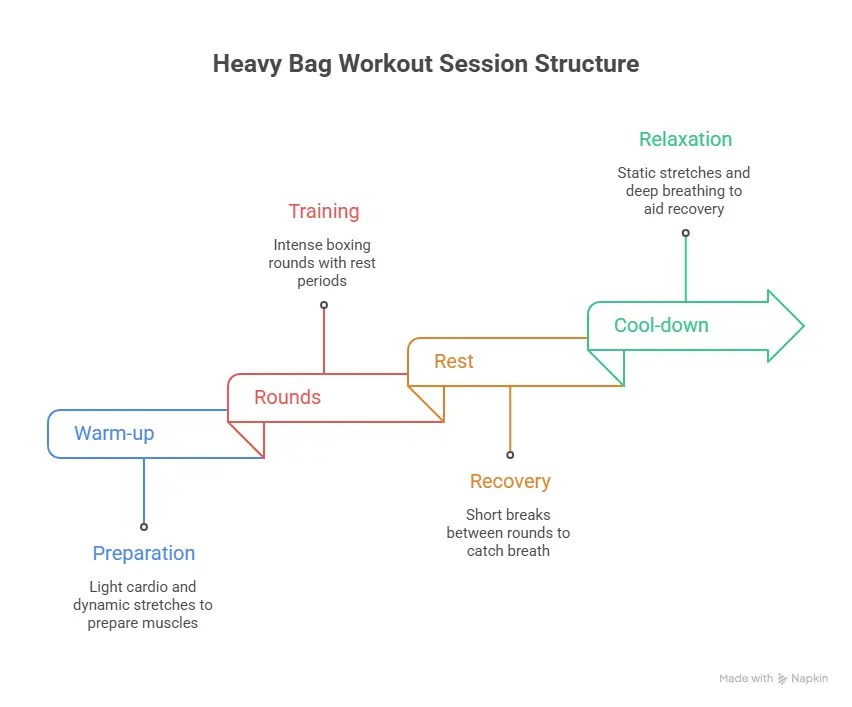
Most boxing heavy bag workout sessions follow the same format used in competitive boxing: timed rounds separated by short recovery periods.

Beginners usually start with two-minute rounds before progressing to three-minute rounds, the standard used in professional bouts. This structure allows athletes to train intensity while still maintaining proper form.

A typical training format might include four to six rounds focused on technique and conditioning.

The Round-Based Training System

Why Round Training Works

Round-based training creates urgency and discipline. Knowing the clock is running forces athletes to maintain focus, while rest intervals provide just enough recovery to sustain performance.

This pattern closely mirrors how real boxing matches unfold, helping the body adapt to the rhythm of competition.

Preparing for Your First Heavy Bag Workout

Warming Up Before Hitting the Bag

A proper warm-up prepares the muscles and joints for impact. Skipping this step increases the risk of wrist or shoulder injuries, especially for beginners.

Most coaches recommend five to ten minutes of light movement before starting heavy bag drills. Activities such as shadowboxing or skipping rope gradually increase heart rate while activating key muscle groups used in punching.

Essential Equipment for Safe Training

Before starting a boxing heavy bag workout, athletes should ensure they have the right gear. Hand protection is particularly important because repetitive impact can strain joints and tendons.

At Spartans Boxing Club, beginners are typically introduced to three basic items:

  • Boxing gloves to cushion impact and protect the knuckles
  • Hand wraps to stabilize the wrist and support small bones in the hand
  • A properly mounted heavy bag that absorbs force safely

These pieces of equipment work together to prevent injury while allowing the athlete to train with confidence.

Beginner Boxing Training on the Heavy Bag

Starting With Simple Combinations

For beginners, heavy bag training begins with mastering fundamental punches rather than throwing complex combinations immediately. Basic strikes create the foundation for all future techniques.

The first combination most athletes learn is the jab-cross sequence, often referred to as the “1–2.” This pairing introduces both lead-hand accuracy and rear-hand power.

Once that movement becomes comfortable, additional punches such as hooks and uppercuts can be added to create more advanced combinations.

Controlling Power and Accuracy

Many beginners assume that hitting the bag harder automatically leads to better results. In reality, experienced coaches encourage new athletes to start at around 50–75 percent power.

This approach allows fighters to focus on accuracy, body alignment, and breathing patterns. Power can always be added later once technique becomes consistent.

Practicing controlled strikes also prevents the bag from swinging excessively, which helps maintain rhythm during combinations.

Developing a Full Body Boxing Workout

One reason heavy bag training is so effective is that it engages nearly every muscle group in the body. While the punches appear to come from the arms, the movement actually begins in the lower body.

Footwork initiates momentum, the core transfers energy, and the shoulders guide the final direction of the strike. This coordinated motion transforms the session into a highly effective full body boxing workout.

Over multiple rounds, athletes experience improvements in strength, endurance, and coordination simultaneously. The result is a training system that builds both athletic performance and overall fitness.

How Heavy Bag Training Builds Boxing Power and Endurance

As athletes progress beyond beginner drills, heavy bag workouts begin to emphasize boxing power and endurance. Longer combinations, faster punch rates, and increased movement around the bag push the body into higher performance zones.

These sessions often incorporate elements of boxing conditioning drills, where fighters alternate between explosive combinations and defensive footwork.

The goal is not just to hit harder but to sustain effective technique even under fatigue. This ability becomes crucial during sparring sessions and competitive bouts.

The Role of Technique in Heavy Bag Training

While conditioning is an important benefit, the heavy bag is ultimately a tool for refining boxing technique training. Every punch thrown against the bag provides immediate feedback.

If the strike lands correctly, the bag moves cleanly. If the technique is flawed, the punch feels awkward or off-balance.

This feedback loop allows athletes to adjust their stance, guard position, and rotation mechanics. Over time, these corrections become automatic.

Experienced trainers also encourage fighters to circle the bag while punching rather than standing still. This movement mimics real fight scenarios and improves spatial awareness.

Transition to Intermediate Heavy Bag Training

Once beginners become comfortable with basic combinations and round timing, their training begins to evolve. The focus shifts from simply hitting the bag to controlling rhythm, movement, and strategy.

Intermediate workouts introduce faster punch sequences, defensive movements, and varied attack angles. These elements prepare athletes for more complex boxing workout routines that challenge both skill and endurance.

Structuring an Effective Heavy Bag Training Session

After mastering the fundamentals, athletes begin to approach the boxing heavy bag workout with greater structure and purpose. Instead of simply throwing punches, each round is designed to focus on a specific goal such as technique refinement, conditioning, or combination building.

At Spartans Boxing Club, trainers typically divide heavy bag sessions into multiple phases. The early rounds emphasize rhythm and accuracy, allowing the athlete to warm into the session. As the workout progresses, the pace increases, forcing the boxer to maintain control even under fatigue.

This structured approach turns heavy bag training into a progressive system rather than a random exercise routine. Over time, athletes develop consistency, which is essential for improving overall boxing performance.

Structuring an Effective Heavy Bag Training Session

The Role of Combination Training in Bag Work

Why Combinations Matter

In boxing, single punches rarely decide the outcome of a round. Instead, fighters rely on combinations that create openings and maintain pressure. A properly designed punching bag workout helps athletes practice these sequences repeatedly until they become second nature.

Combinations train both offensive rhythm and defensive awareness. When punches flow together, the boxer learns how to move their body efficiently while maintaining balance. This fluid motion becomes crucial during sparring sessions where reaction time determines success.

Heavy bag training also allows athletes to experiment with different patterns. A jab-cross-hook combination may transition into a body shot or an uppercut depending on how the bag moves. This adaptability mirrors the unpredictability of real boxing exchanges.

Building Rhythm Through Repetition

Consistency plays a major role in effective boxing technique training. Throwing combinations repeatedly against the heavy bag strengthens neural pathways that control movement patterns.

As the boxer becomes more comfortable, combinations naturally become faster and more precise. Trainers often encourage fighters to focus on smooth transitions between punches rather than brute force. The goal is to maintain rhythm while gradually increasing speed.

This balance between speed and technique is what ultimately separates beginner boxers from intermediate athletes.

Developing a Complete Boxing Conditioning System

Training for Boxing Cardio Endurance

Heavy bag sessions are widely recognized as one of the most effective forms of boxing cardio workout training. Each round pushes the cardiovascular system to sustain bursts of explosive movement followed by short recovery intervals.

During intense rounds, heart rates rise quickly as the athlete throws rapid combinations and moves around the bag. The brief rest period between rounds allows partial recovery before the next surge of activity begins.

This repeated cycle strengthens the body’s ability to deliver oxygen to working muscles. Over time, boxers experience improved stamina and faster recovery during training.

Studies published through institutions such as the National Strength and Conditioning Association highlight interval-style combat sports training as a powerful method for building both aerobic and anaerobic endurance.

Strength and Explosive Power Development

While cardio endurance is a major benefit, heavy bag training also develops muscular strength. Every punch requires coordinated force from the legs, core, shoulders, and arms.

As athletes progress through structured heavy bag boxing training, the body becomes more efficient at generating power. This leads to improved striking ability and greater overall athletic performance.

The heavy bag also absorbs impact while providing resistance, which strengthens the joints and connective tissues involved in punching mechanics. This gradual adaptation allows fighters to strike harder without increasing injury risk.

Integrating Footwork Into Heavy Bag Training

Movement Around the Bag

One of the most common mistakes beginners make is standing directly in front of the bag and throwing punches without moving. Real boxing rarely occurs in a fixed position, which is why coaches emphasize constant movement during heavy bag sessions.

Circling the bag forces the athlete to adjust angles while maintaining balance. This movement replicates how fighters reposition themselves during exchanges in the ring.

Practicing this movement also improves spatial awareness. The boxer learns how to control distance, step in for combinations, and pivot out of danger.

According to technical insights from the coaches at Evolve MMA, integrating footwork drills into bag training dramatically improves defensive awareness and counterattacking ability.

Linking Footwork and Punching

Once footwork becomes comfortable, athletes begin to link movement directly with their punching sequences. For example, stepping forward while throwing a jab helps maintain pressure on the opponent.

Pivoting after a hook allows the boxer to exit at an angle while staying balanced. These subtle movements allow combinations to flow naturally without leaving the athlete vulnerable.

Over time, this coordination transforms heavy bag training into a realistic simulation of boxing movement.

Advanced Combination Strategies for the Heavy Bag

As athletes gain confidence, heavy bag workouts begin to incorporate longer and more complex combinations. These sequences require coordination, endurance, and strategic timing.

Instead of repeating simple two-punch combinations, intermediate boxers begin to chain together three or four punches in rapid succession. For example, a jab-cross-hook sequence may lead directly into a body shot or uppercut.

This complexity forces the boxer to maintain control over both technique and breathing. The body must remain relaxed while generating force, which is a hallmark of experienced fighters.

Training resources from platforms such as FightCamp emphasize that advanced bag drills should prioritize fluidity rather than brute strength. Power naturally increases when movement patterns become efficient.

Turning Bag Work Into a Full Boxing Workout Routine

Integrating Conditioning and Technique

A well-designed boxing workout routine combines multiple training elements within a single session. Heavy bag rounds form the core of this structure, but they are supported by additional drills that reinforce technique and endurance.

At Spartans Boxing Club, coaches often integrate shadowboxing and conditioning exercises between rounds. These intervals help athletes maintain movement while giving the arms a brief recovery from continuous punching.

This combination of technical drills and conditioning creates a balanced workout that develops both athletic performance and boxing skill simultaneously.

Building a Sustainable Training Habit

Consistency is the key factor behind long-term improvement in boxing. Athletes who train regularly see steady progress in coordination, stamina, and punching power.

Heavy bag workouts are particularly effective because they can be adapted to different fitness levels. Beginners may start with shorter rounds and slower combinations, while experienced fighters push their limits with longer sessions and more complex drills.

Over time, this adaptability makes heavy bag training one of the most sustainable forms of boxing fitness training.

How Spartans Boxing Club Uses Heavy Bag Training

At Spartans Boxing Club, heavy bag sessions are integrated into nearly every class format. From beginner sessions to advanced sparring preparation, the bag provides a reliable platform for developing both physical and technical skills.

Members are guided through structured rounds that emphasize precision, endurance, and discipline. Trainers encourage athletes to maintain proper technique while gradually increasing intensity.

For new members exploring their first boxing experience, the club’s First Timers program provides a guided introduction to the training environment. This approach ensures that beginners build strong fundamentals before advancing into more demanding workouts.

Heavy bag training is also central to the philosophy behind the club’s Spartans Boxing Academy, where athletes learn structured training systems used by professional fighters.

The Mental Discipline of Heavy Bag Training

Beyond physical conditioning, the heavy bag also builds mental resilience. Each round requires focus, determination, and controlled breathing under pressure.

As fatigue sets in, the athlete must maintain technique and composure. This challenge strengthens mental discipline, which is essential for boxing success.

Experienced fighters often describe the heavy bag as a training partner that never stops demanding effort. The repetitive rhythm of punches becomes almost meditative, allowing athletes to sharpen their focus and control their breathing.

Over time, this mental endurance becomes just as important as physical conditioning.

Preparing for Advanced Heavy Bag Workouts

Once athletes become comfortable with combination drills, footwork integration, and endurance training, they are ready to explore more advanced heavy bag techniques.

These methods involve higher intensity intervals, defensive slips, and strategic targeting of head and body zones. Fighters begin to treat the bag as if it were a real opponent, incorporating feints, counters, and directional movement.

Transitioning to Advanced Heavy Bag Training

By the time athletes reach the advanced stage of a boxing heavy bag workout, the focus shifts from basic combinations to strategic training. The heavy bag becomes less of a simple conditioning tool and more of a simulation partner that mirrors real fight dynamics.

Experienced fighters treat every round on the bag as if they were facing an opponent. They visualize attacks, counters, and defensive reactions while maintaining constant movement. This mindset transforms repetitive training into tactical preparation.

At Spartans Boxing Club, coaches often remind fighters that the heavy bag does not just build strength. It develops awareness, discipline, and adaptability. These qualities separate recreational fitness training from high-level boxing performance.

Advanced Heavy Bag Drills for Performance

Targeting Head and Body Transitions

A common feature of advanced heavy bag boxing training is the deliberate change of targets during combinations. Instead of striking only the upper portion of the bag, fighters move fluidly between head-level punches and body shots.

This variation mimics real boxing exchanges where fighters constantly shift their attacks to break through defensive guards. Practicing these transitions improves accuracy while forcing the athlete to bend their knees and engage the core.

Body shots also require more rotational force, which strengthens the torso and reinforces proper punching mechanics.

Increasing Speed and Punch Volume

Another hallmark of advanced boxing conditioning drills is the ability to maintain speed over longer rounds. Fighters gradually increase the number of punches thrown within a short time frame, forcing the body to operate efficiently under fatigue.

This method improves both endurance and coordination. Rather than focusing on individual strikes, the athlete learns to sustain rapid combinations without sacrificing technique.

Speed drills are particularly effective when integrated into timed intervals. Short bursts of explosive punching followed by brief recovery periods mimic the intensity of competitive boxing rounds.

The Importance of Defensive Awareness During Bag Work

Simulating Real Fight Scenarios

While the heavy bag is primarily used for offensive training, advanced fighters also incorporate defensive movement into their sessions. After each combination, the boxer may slip, roll, or pivot as if avoiding an incoming punch.

These movements train the body to react automatically during sparring. Instead of standing still after punching, the athlete develops the habit of repositioning immediately.

This defensive awareness transforms the punching bag workout from a static drill into a realistic simulation of a boxing match.

Integrating Head Movement and Angles

Head movement is another critical component of advanced boxing technique training. After landing a combination, fighters often practice slipping to the side or ducking under imaginary counterattacks.

This motion forces the athlete to maintain balance while shifting weight quickly. The result is a smoother transition between offense and defense.

Preventing Injuries During Heavy Bag Training

Heavy bag training is powerful but demanding. Without proper preparation and technique, repeated impact can strain the wrists, shoulders, and elbows.

At Spartans Boxing Club, trainers emphasize that long-term progress depends on balancing intensity with recovery. Fighters are encouraged to listen to their bodies and gradually increase workload rather than pushing to exhaustion immediately.

Several factors contribute to safe training:

  • Proper hand wrapping and glove selection
  • Controlled punching technique with full body rotation
  • Adequate recovery between training sessions

When these precautions are followed, heavy bag training becomes one of the safest and most effective forms of boxing fitness training available.

Creating a Long-Term Heavy Bag Training Plan

Frequency and Progression

For most athletes, the ideal training frequency for a boxing heavy bag workout is two to three sessions per week. This schedule allows the body to recover while still maintaining consistent progress.

Beginners often start with shorter sessions focused on technique. As conditioning improves, the number of rounds and punch intensity gradually increase.

This progressive approach prevents burnout while allowing athletes to build boxing power and endurance steadily over time.

Integrating Bag Work With Other Boxing Training

Heavy bag training is most effective when combined with complementary exercises. Shadowboxing, pad work, and strength conditioning each play a role in developing a complete boxing skill set.

At Spartans Boxing Club, athletes often combine bag sessions with structured classes that reinforce movement, rhythm, and coordination. Programs like the Spartans Mind performance training system emphasize the mental focus required for sustained improvement.

This integrated approach ensures that athletes develop both technical skill and overall fitness.

The Role of Heavy Bag Training in Modern Boxing Fitness

Heavy bag workouts are no longer limited to professional fighters. Today, they are widely used by people seeking a challenging and engaging form of exercise.

A well-designed full body boxing workout can deliver cardiovascular benefits, strength development, and stress relief within a single session. This combination makes boxing one of the most efficient training methods available.

Fitness organizations such as the American College of Sports Medicine highlight combat-style workouts as effective tools for improving cardiovascular health and muscular endurance.

Because the heavy bag engages the entire body, it naturally promotes balanced physical development.

Training at Spartans Boxing Club

Spartans Boxing Club has built its reputation by combining authentic boxing training with a supportive community environment. Heavy bag workouts form a central part of the club’s training philosophy.

Members train through structured rounds that emphasize discipline, technique, and endurance. Coaches guide participants through progressive drills that build confidence while ensuring proper form.

For individuals who want to experience this training firsthand, the club’s First Timers program provides a welcoming introduction to boxing fundamentals. Beginners learn how to wrap their hands, throw basic combinations, and complete their first heavy bag rounds safely.

More experienced athletes can explore advanced training environments at locations such as Spartans Boxing Club Pasir Ris or other Spartans gyms across Asia and the Middle East.

How Heavy Bag Workouts Transform Fitness and Discipline

Beyond its physical benefits, the heavy bag teaches consistency and perseverance. Each round demands focus, patience, and determination.

Athletes quickly discover that improvement comes through repetition. The same combinations practiced hundreds of times eventually become automatic movements.

This process builds confidence both inside and outside the gym. The discipline developed through boxing workout routine training often carries into other areas of life, reinforcing habits of persistence and self-control.

Conclusion: Mastering the Boxing Heavy Bag Workout

The boxing heavy bag workout remains one of the most powerful training methods in combat sports. It develops punching power, cardiovascular endurance, coordination, and mental resilience within a single training system.

Beginners benefit from learning basic combinations and controlled punching mechanics. As athletes progress, heavy bag training evolves into a sophisticated practice that incorporates movement, strategy, and defensive awareness.

At Spartans Boxing Club, the heavy bag is more than a piece of equipment. It represents a foundation for disciplined training and continuous improvement. Through structured rounds, athletes build the strength, stamina, and confidence needed to succeed in boxing and beyond.

Boxing Weight Training The Complete Guide to Building Power, Endurance, and Ring Performance

Boxing Weight Training: The Complete Guide to Building Power, Endurance, and Ring Performance

By Blog

Boxing is often associated with speed, agility, and cardiovascular endurance. Yet behind every explosive punch and controlled movement in the ring lies a structured strength foundation. Boxing weight training has become an essential part of modern fighter preparation because it develops functional power without sacrificing mobility or speed.

At Spartans Boxing Club, trainers treat strength work as a performance tool rather than a bodybuilding exercise. Properly designed programs help fighters produce stronger punches, improve durability, and maintain stamina deep into later rounds. When integrated correctly with skill training, weight sessions enhance boxing athletic performance while protecting the body from injury.

Across boxing gyms in climates such as Singapore, Dubai, Australia, and the Philippines, efficient strength routines also help fighters manage fatigue caused by heat and humidity. The goal is not simply lifting heavier weights, but building usable strength that translates directly into sharper combinations, better footwork, and more resilient fighters.

Understanding how boxing weight training works is the first step toward creating a smarter training strategy.

Why Boxing Weight Training Matters for Fighters

Boxers rely on coordinated movement from the ground up. Every punch begins with the feet pushing against the floor, travels through the hips and core, and finishes with the upper body delivering force through the arms and shoulders. Without sufficient strength in these areas, power generation becomes inefficient.

Boxing strength training targets these movement chains so fighters can produce more force while remaining balanced. This approach differs from traditional bodybuilding programs because it prioritizes athletic function over muscle size.

The impact of structured strength work becomes clear in three areas of boxing performance:

  • Increased punching power due to stronger hips and core rotation
  • Greater boxing muscle endurance for maintaining output during long rounds
  • Improved injury resistance through stronger joints and connective tissues

These benefits are supported by research from the National Strength and Conditioning Association, which highlights the importance of resistance training in combat sports performance. When programmed correctly, strength work improves both explosive output and fatigue resistance without reducing mobility.

For boxers who train regularly in hot or humid environments, strength efficiency becomes even more important. Structured programs allow athletes to train harder while minimizing unnecessary fatigue.

Understanding the Role of Strength Training for Boxers

Many beginners worry that lifting weights will make them bulky and slow. This misconception comes from bodybuilding-style training that focuses heavily on muscle hypertrophy. Boxing programs take a different approach.

Strength training for boxers emphasizes explosive movements, moderate weights, and efficient repetition ranges. Instead of maximizing muscle size, the goal is improving force production and neuromuscular coordination.

In practical terms, this means training methods that support movement patterns used in boxing:

  • Rotational power for hooks and crosses
  • Hip drive for explosive punches
  • Shoulder endurance for sustained combinations

According to guidance from the American Council on Exercise, functional strength programs built around compound movements improve athletic output far more effectively than isolated exercises.

This philosophy forms the foundation of boxing performance training programs used in competitive gyms around the world. Rather than separating strength work from skill training, the two systems support each other.

Core Principles Behind Effective Boxing Weight Training

A well-designed boxing strength program follows several key principles that ensure improvements translate directly into ring performance. These principles are widely used in elite training environments and form the backbone of professional fighter preparation.

Functional Strength Over Aesthetics

The goal of boxing weight training is not to build larger muscles but to create efficient movement patterns. Fighters benefit from exercises that replicate real boxing actions such as rotation, pushing, pulling, and explosive hip extension.

Compound lifts are therefore prioritized because they engage multiple muscle groups simultaneously. Exercises like squats and deadlifts mimic the lower-body drive needed for powerful punches.

Research highlighted by USA Boxing emphasizes that functional strength training improves striking power and athletic resilience while maintaining speed.

Balance Between Strength and Speed

Boxers must maintain quick reactions and fast hand speed. Heavy lifting alone can create unnecessary fatigue if not balanced with explosive training.

This is why power training for boxing typically includes movements such as medicine ball throws and jump squats. These exercises train the nervous system to generate force quickly rather than slowly grinding through heavy repetitions.

Progressive Adaptation

Strength gains occur gradually as the body adapts to increased resistance. Proper resistance training for fighters follows structured progression where intensity increases over time while recovery remains adequate.

Without this balance, athletes risk overtraining or developing excessive soreness that interferes with boxing sessions.

Key Muscle Groups Targeted in Boxing Weight Training

Boxing relies on coordinated whole-body movement. A fighter who trains only the arms will never generate the same power as one who develops strength throughout the entire kinetic chain.

Lower Body: The Foundation of Punching Power

Most punching force originates from the legs and hips. When fighters drive their feet into the floor, they generate ground reaction force that travels through the body.

Exercises such as squats and lunges build the leg strength required for explosive movement. These lifts also support footwork, balance, and defensive movement.

According to sports science research published by the Journal of Strength and Conditioning Research, lower-body strength is strongly correlated with punching force in combat athletes.

Core: The Engine of Rotational Power

The core transfers energy from the lower body to the upper body. Without a strong midsection, power dissipates before reaching the fists.

Core-focused training therefore plays a major role in boxing conditioning workouts. Rotational exercises like medicine ball slams and cable twists reinforce the same movement patterns used in punches.

Upper Body: Stability and Endurance

While the legs generate power, the shoulders and arms must deliver it efficiently. Strong shoulders stabilize punches and protect joints from overuse injuries.

Pull-ups, push-ups, and pressing movements strengthen the upper body without creating excessive muscle bulk. These exercises support sustained punching output and improve defensive guard endurance.

Best Exercises for Boxing Weight Training

The effectiveness of any strength program depends on exercise selection. Certain movements consistently appear in elite boxing programs because they replicate athletic actions used in the ring.

Deadlifts and Squats for Explosive Drive

Deadlifts and squats remain foundational lifts in strength and conditioning for boxing programs. These exercises develop hip extension and lower-body strength that translate directly into punching force.

Training them in moderate rep ranges helps fighters gain strength while maintaining speed.

Medicine Ball Training for Rotational Power

Medicine ball exercises bridge the gap between weightlifting and boxing movement patterns. Slams and rotational throws reinforce explosive core engagement.

These movements closely mimic the mechanics of hooks and body shots, making them highly valuable for fighters.

Pull-Ups and Presses for Upper Body Strength

Upper body pulling and pushing movements maintain muscular balance. Pull-ups strengthen the back and shoulders, while presses support punching mechanics.

Moderate intensity prevents stiffness while maintaining joint health and endurance.

Equipment Used in Boxing Weight Training

Modern boxing gyms combine traditional strength equipment with sport-specific tools to create versatile training environments.

Barbells and dumbbells remain essential for compound lifts, while kettlebells and medicine balls introduce explosive movements. Many fighters also incorporate resistance bands to reinforce punching mechanics without excessive load.

These tools are commonly available in training centers and fitness retailers such as Everlast Boxing and other combat sports equipment providers.

Integrating Weight Training into a Boxing Fitness Program

One of the biggest mistakes beginners make is separating strength training entirely from boxing practice. Effective training systems integrate both components so they complement each other.

Most structured boxing fitness programs schedule strength sessions two to three times per week alongside technical boxing sessions. This balance allows athletes to build strength without compromising skill development.

For those new to boxing, structured programs available through the Spartans Boxing Academy provide guided instruction on combining boxing drills with physical conditioning. These programs emphasize skill progression while ensuring physical preparation supports long-term performance.

Transition to Advanced Programming

Understanding the fundamentals of boxing weight training provides a strong foundation for improving performance. Yet beginners often struggle with one critical question: how should these exercises be organized into an effective training routine?

The answer lies in structured programming that balances strength, conditioning, recovery, and boxing practice. Without this structure, even the best exercises can fail to deliver real performance improvements.

Structuring an Effective Boxing Weight Training Program

Designing a training plan is where boxing weight training becomes truly impactful. Exercises alone are not enough. The way sessions are organized determines whether strength improvements translate into sharper punches, faster reactions, and stronger endurance in the ring.

Experienced coaches at Spartans Boxing Club emphasize that strength sessions must support boxing skill development rather than compete with it. The objective is to improve physical capacity without exhausting the athlete before technical training. When strength work and boxing sessions are aligned correctly, fighters experience noticeable gains in boxing athletic performance while maintaining agility and speed.

A structured program balances resistance training, boxing drills, recovery, and conditioning so that progress happens consistently without unnecessary fatigue.

How Often Should Boxers Train with Weights?

Training frequency is one of the most common questions for beginners exploring strength training for boxers. Too little strength work limits progress, while too much lifting can interfere with boxing technique sessions.

Most effective programs schedule weight training two to three times per week. This frequency allows fighters to build strength while leaving enough energy for sparring, pad work, and conditioning sessions.

In many gyms around the world, including Spartans Boxing Club locations, strength sessions are often scheduled after boxing practice. This approach ensures that technical skills remain the primary focus when energy levels are highest.

Sports performance research discussed by the National Academy of Sports Medicine highlights that strength training integrated with skill training improves athletic output while maintaining optimal recovery cycles.

The Ideal Weekly Boxing Weight Training Schedule

While every fighter has different goals and competition timelines, most training systems follow a similar structure. A balanced schedule allows athletes to develop strength while maintaining high-quality boxing sessions.

A typical week often includes boxing technical training on most days, combined with strength work on alternating days. This approach ensures that muscle recovery occurs while boxing skills continue to develop.

Strength sessions are usually limited to about 45 minutes. Longer workouts can reduce punching sharpness in later boxing drills and may increase fatigue in warmer environments such as Singapore or Dubai.

For fighters training consistently, the key is not doing more exercises but performing the right exercises with focus and efficiency.

Periodization: The Secret Behind Elite Boxing Strength Programs

Advanced boxing training programs rarely follow the same routine every week. Instead, they use structured phases known as periodization to gradually build strength, power, and endurance.

Periodization is widely recommended by organizations such as the International Sports Sciences Association, which explains that athletes perform best when training intensity changes over time.

In boxing performance training, this typically involves three major phases that repeat over multiple weeks.

Strength Development Phase

During this phase, fighters focus on heavier compound movements that build foundational strength. Exercises like squats, deadlifts, and presses are performed with controlled intensity to strengthen the entire kinetic chain.

Developing this base allows fighters to produce more force during punches and defensive movements.

Power Development Phase

Once foundational strength improves, the focus shifts toward explosive movements. Exercises become faster and more dynamic.

This phase introduces medicine ball throws, jump squats, and other forms of power training for boxing that teach the body to generate force rapidly.

Fight Preparation Phase

Closer to sparring cycles or competitions, strength training becomes lighter and faster. The focus moves toward endurance, speed, and maintaining freshness.

This stage integrates conditioning circuits and movement-based exercises that reinforce boxing conditioning workouts.

Combining Boxing Conditioning and Strength Training

One of the most effective approaches in modern boxing is combining conditioning and strength work within the same training system. This method ensures fighters develop both stamina and power simultaneously.

Traditional boxing conditioning focuses on activities such as jump rope, heavy bag rounds, and pad work. When paired with resistance exercises, athletes build both aerobic endurance and muscular strength.

Many coaches design sessions that alternate between boxing drills and strength movements. For example, a fighter may complete a short bag round followed by an explosive strength exercise.

This style of training reinforces boxing muscle endurance, allowing athletes to sustain punching output even in later rounds when fatigue becomes a factor.

Research published by the British Journal of Sports Medicine highlights that mixed conditioning methods improve athletic resilience and reduce fatigue during combat sports.

Equipment Selection for Effective Boxing Weight Training

Although many boxing exercises can be performed with minimal equipment, certain tools consistently appear in well-designed programs.

Barbells and dumbbells remain the foundation for compound lifts, while kettlebells introduce dynamic movements that enhance coordination and grip strength. Medicine balls are particularly valuable because they mimic the rotational mechanics used in punching.

Resistance bands are also widely used in resistance training for fighters because they allow athletes to reinforce punching mechanics without heavy loading on joints.

Fitness retailers and boxing equipment specialists such as Ringsport Australia often supply many of these tools used in boxing gyms across Asia and the Middle East.

Adapting Strength Training for Hot and Humid Climates

Boxing is practiced globally, and many fighters train in climates that place additional stress on the body. Cities like Singapore, Dubai, and Phnom Penh often experience high humidity levels that can accelerate fatigue during intense workouts.

When designing strength and conditioning for boxing, trainers often shorten weight sessions and emphasize efficiency. Shorter sets, longer rest intervals, and proper hydration strategies help fighters maintain performance without overheating.

Environmental stress also increases the importance of recovery. Adequate rest between sessions ensures that strength gains occur without compromising boxing technique training.

This approach helps fighters maintain consistency even in challenging training conditions.

Preventing Overtraining in Boxing Weight Training

One of the biggest risks when combining boxing with strength work is excessive training volume. Fighters often push themselves beyond recovery limits in pursuit of faster results.

However, strength gains occur during recovery rather than during workouts themselves. Overloading the body with constant heavy lifting can reduce punching speed, increase soreness, and elevate injury risk.

Professional boxing coaches typically monitor training intensity carefully and adjust programs when fatigue becomes noticeable. Recovery techniques such as mobility exercises, stretching routines, and proper sleep play a crucial role in sustaining progress.

According to sports science insights from the Cleveland Clinic, structured recovery improves athletic output while reducing the risk of chronic fatigue.

Integrating Strength Training with Boxing Skill Development

For fighters who train regularly, the ultimate goal of boxing weight training is not lifting heavier weights but improving skill execution inside the ring.

Strength work should support better footwork, stronger punches, and greater endurance during sparring sessions. This means training movements that closely match boxing mechanics rather than isolating individual muscles.

Many Spartans Boxing Club programs integrate strength exercises directly into boxing circuits so that fighters experience seamless transitions between conditioning, power development, and technical drills.

Athletes exploring structured boxing programs can learn more about beginner training pathways through the First Timers Guide, which explains how new members build both skill and fitness progressively.

Preparing for the Final Stage: Advanced Training Strategies

By now, the foundations of boxing strength training are clear. Fighters benefit most when weight training supports skill development, when workouts follow structured cycles, and when recovery remains a priority.

Yet there are still several advanced topics that determine long-term success in boxing performance. Many athletes struggle with issues such as poor exercise selection, improper nutrition, and inefficient recovery habits.

These mistakes can prevent strength gains from translating into real improvements inside the ring.

Advanced Strategies for Maximizing Boxing Weight Training Results

The final stage of developing an effective boxing weight training program focuses on refinement. By the time fighters reach this level, they already understand how strength supports punching power, endurance, and athletic movement. The next step is optimizing training variables such as nutrition, recovery, and technique consistency.

Elite fighters do not rely on random workouts. Instead, they follow structured systems that combine boxing strength training, conditioning work, and performance monitoring. These strategies allow athletes to sustain progress over months and years rather than experiencing short bursts of improvement followed by plateaus.

For trainers at Spartans Boxing Club, the objective is always the same. Strength training must improve what happens inside the ring. Every exercise, recovery strategy, and training cycle should ultimately contribute to better timing, sharper punches, and improved resilience during demanding rounds.

The Role of Nutrition in Boxing Strength Development

Strength training cannot produce meaningful results without proper nutritional support. Boxing requires a balance between power, endurance, and body composition, which means fighters must fuel their bodies carefully.

Protein intake is particularly important because resistance training creates microscopic muscle stress that must be repaired and strengthened during recovery. Sports nutrition research published by the International Society of Sports Nutrition shows that athletes performing resistance training for fighters benefit from consistent protein intake to support muscle repair and strength gains.

Carbohydrates also play an important role. Boxing sessions and boxing conditioning workouts require significant energy, especially in warm environments where dehydration can accelerate fatigue. Adequate carbohydrate intake ensures fighters maintain high training intensity throughout their sessions.

Hydration becomes especially important for athletes training in tropical climates. Fighters in cities such as Dubai or Singapore often lose more fluids during training, making electrolyte balance critical for maintaining performance.

The Role of Nutrition in Boxing Strength Development

Recovery: The Hidden Driver of Strength Gains

Many fighters focus heavily on training intensity but underestimate the importance of recovery. In reality, strength improvements occur after the workout, when the body repairs and strengthens muscle tissue.

Proper sleep plays a critical role in this process. During deep sleep cycles, the body releases hormones responsible for muscle repair and recovery. Athletes who consistently sleep well recover faster and perform better in subsequent training sessions.

Mobility work is another essential component of recovery. Boxing places repeated stress on shoulders, hips, and ankles. Without mobility training, these joints may become stiff, reducing both punching speed and movement efficiency.

Organizations such as the American College of Sports Medicine highlight recovery as a fundamental element of athletic performance. Fighters who integrate recovery strategies into their strength and conditioning for boxing programs maintain long-term performance while reducing injury risk.

Common Mistakes in Boxing Weight Training

Even experienced athletes can make mistakes when integrating strength work into their boxing routines. Many of these errors occur when fighters attempt to copy bodybuilding-style training rather than sport-specific programs.

One frequent mistake is lifting excessively heavy weights with slow movements. While heavy lifting can build strength, boxing requires rapid force production. Training exclusively with maximal loads may increase fatigue without improving boxing athletic performance.

Another common issue is neglecting mobility and warm-up routines. Boxing movements rely heavily on joint mobility, especially in the shoulders and hips. Without proper preparation, fighters may develop imbalances that reduce power output and increase injury risk.

Finally, many athletes underestimate the importance of technical consistency. Strength training is most effective when exercises mirror the movement patterns used in boxing.

Injury Prevention Through Smart Strength Training

One of the most valuable benefits of boxing weight training is injury prevention. Strong muscles stabilize joints and absorb impact forces that would otherwise stress tendons and ligaments.

Boxers frequently experience strain in areas such as the shoulders, wrists, and lower back. These regions absorb repeated stress from punching and defensive movements. Strength training builds resilience in these areas, reducing the likelihood of chronic injuries.

Training programs often emphasize movement quality rather than sheer weight lifted. Exercises performed with controlled technique strengthen stabilizing muscles that support the joints during explosive movements.

According to guidance from the Mayo Clinic, structured strength training improves joint stability and overall musculoskeletal health. For boxers who train multiple times per week, these benefits are essential for maintaining consistent performance.

Building a Sustainable Boxing Fitness Program

Long-term success in boxing requires more than short bursts of motivation. Fighters who maintain progress over time typically follow structured systems that integrate strength, conditioning, and skill development.

A sustainable boxing fitness program evolves as the athlete improves. Beginners focus on mastering basic strength movements and building endurance. As experience increases, training becomes more specialized with greater emphasis on explosive power and technical refinement.

At Spartans Boxing Club, training programs are designed to guide athletes through these stages progressively. Structured coaching ensures that fighters build strength safely while developing technical boxing skills.

Athletes interested in deeper performance training can explore advanced programs such as Spartans Mind, which focuses on both physical preparation and mental resilience for boxing performance.

How Boxing Weight Training Enhances Competitive Performance

In competitive boxing, small performance improvements can make a significant difference. Increased punching power, improved endurance, and stronger defensive movement can determine the outcome of a match.

Strength training plays a critical role in developing these attributes. Fighters who consistently train their lower body, core, and upper body together develop more efficient force transfer through the kinetic chain.

Over time, these improvements result in sharper combinations, stronger defensive stability, and improved ability to maintain output during demanding rounds.

Professional fighters across international boxing communities rely heavily on boxing performance training methods that integrate strength and conditioning with technical development.

Training for Different Types of Boxers

Not all fighters train for the same goals. Amateur competitors, fitness enthusiasts, and professional athletes may each approach boxing weight training differently depending on their objectives.

A recreational athlete may prioritize endurance and general fitness, while a competitive fighter may focus on explosive power and technical efficiency. Trainers therefore adapt strength programs to match the athlete’s specific goals.

For those exploring boxing as a long-term discipline, structured programs offered through the Spartans Boxing Academy provide a clear progression path from beginner to advanced training.

This gradual progression ensures that athletes build strength and technical skill simultaneously without rushing development.

The Future of Boxing Strength Training

As sports science continues to evolve, boxing strength programs are becoming more sophisticated. Trainers increasingly rely on data-driven methods to track athlete performance and optimize training loads.

Technology such as wearable trackers and performance monitoring tools allows coaches to measure fatigue, recovery, and training intensity. These insights help fighters maintain optimal performance while avoiding overtraining.

Modern boxing gyms are also integrating functional training methods that emphasize movement quality and explosive power rather than traditional gym routines.

These innovations are shaping the next generation of strength training for boxers, ensuring athletes train smarter rather than simply harder.

Conclusion: Building Stronger Fighters Through Boxing Weight Training

The role of boxing weight training has evolved significantly over the past decade. Once considered optional, it is now recognized as a core component of fighter development. Strength training improves punching power, enhances endurance, and protects the body from injury during demanding training cycles.

When combined with technical boxing practice, structured strength programs create well-rounded athletes capable of performing at high levels. The key lies in functional training that supports movement efficiency rather than purely aesthetic muscle growth.

At Spartans Boxing Club, strength training is approached as a performance tool that supports the entire boxing journey. From beginners learning basic techniques to experienced fighters refining their skills, the integration of strength and conditioning continues to play a vital role in building stronger, more resilient athletes.

By understanding the principles behind boxing conditioning workouts, recovery strategies, and progressive strength development, fighters can unlock their full potential and continue improving both inside and outside the ring.

Best Shoes for Boxing Training How the Right Footwear Improves Speed, Balance, and Performance

Best Shoes for Boxing Training: How the Right Footwear Improves Speed, Balance, and Performance

By Blog

Boxing is often described as a sport of precision, timing, and movement. While punching power and endurance usually get the spotlight, experienced coaches know that performance starts from the ground up. The ability to move smoothly, pivot quickly, and maintain balance depends heavily on footwear.

That is why choosing the best shoes for boxing training becomes a fundamental decision for anyone stepping into the gym.

At Spartans Boxing Club, trainers consistently remind beginners that boxing is essentially controlled movement. Every jab, hook, and defensive slip begins with foot positioning.

The wrong footwear can slow reaction time, reduce traction on the canvas, and even increase the risk of ankle injuries. The right footwear, on the other hand, creates stability, improves agility, and supports proper boxing mechanics.

This guide explains how boxing footwear works, why it matters, and how fighters can choose the right pair based on training style and environment.

Why Boxing Shoes Matter More Than Most People Think

Many newcomers assume that any athletic shoe will work for boxing training. Running shoes, cross trainers, or basketball sneakers often appear suitable at first glance. However, boxing training involves unique movement patterns that typical athletic footwear is not designed to support.

Running shoes are designed for forward movement and cushioning. Boxing training requires lateral movement, pivoting, and rapid directional shifts. Thick cushioning actually reduces ground feel, making footwork slower and less precise.

Specialized boxing training shoes solve this problem by prioritizing grip, flexibility, and lightweight construction. According to research highlighted in this guide from Lisa Johnson Fitness, boxing shoes typically feature flat soles and minimal cushioning to improve balance and responsiveness.

For fighters training in high-humidity regions such as Singapore or the Philippines, footwear design becomes even more important. Breathable materials help manage sweat, while gum rubber soles maintain traction on gym floors.

The Role of Footwork in Boxing Performance

Footwork is the foundation of boxing. Even the most powerful punchers rely on movement to control distance, set angles, and maintain defensive positioning.

Professional fighters spend countless hours refining movement patterns like pivots, shuffles, and lateral slides. These movements demand footwear that responds quickly to pressure shifts.

The best footwear for boxing supports three critical performance factors:

  • Stability during rapid direction changes
    • Grip during pivots and rotations
    • Lightweight movement without restricting speed

Traditional athletic shoes tend to interfere with these elements. Thick midsoles slow down pivots, while rigid outsoles reduce flexibility. In contrast, boxing footwork training shoes allow fighters to stay connected to the canvas while moving with precision.

What Makes the Best Shoes for Boxing Training

Not all boxing shoes are identical. While they share certain design principles, subtle differences in materials and structure affect how they perform in training.

Understanding these features helps fighters make smarter decisions when choosing their footwear.

Lightweight Construction

Speed matters in boxing. Heavy shoes create unnecessary resistance during movement drills, shadowboxing, and sparring. That is why many athletes choose lightweight boxing shoes designed to feel almost like a second skin.

Minimal weight improves agility and reduces fatigue during long training sessions. Fighters who practice advanced footwork combinations particularly benefit from lighter footwear.

Brands like adidas and Venum have developed models specifically engineered for speed-focused training environments. Many of these shoes use mesh fabrics and flexible outsoles to maintain responsiveness.

Flat, Flexible Soles

The sole design of boxing shoes differs significantly from that of typical gym footwear. Instead of thick foam cushioning, boxing shoes use thin, flat rubber soles.

This design allows fighters to maintain better contact with the floor, improving balance and control. Pivoting becomes smoother because the foot can rotate naturally without resistance from bulky materials.

Flat soles also help distribute weight evenly across the foot. When throwing punches, this stability allows power to transfer efficiently from the legs through the hips and shoulders.

Professional fighters often prefer boxing ring shoes with gum rubber outsoles because they provide excellent grip on canvas surfaces.

Breathability for Long Training Sessions

Boxing gyms can become extremely warm environments, particularly in tropical climates like Cambodia, Dubai, and Singapore. Long rounds of bag work and sparring quickly increase body temperature, which leads to sweating.

Footwear that traps heat can cause discomfort, blisters, and reduced performance.

For this reason, many athletes look for breathable boxing shoes that incorporate mesh panels or ventilated materials. These designs allow airflow while maintaining the structural support required for intense movement.

High-Top vs Low-Top Boxing Shoes

One of the most debated topics in boxing footwear is ankle height. Fighters often choose between high-top or low-top designs depending on their training style.

High-Top Boxing Shoes

High-top boxing shoes provide additional ankle stability, which can be particularly useful during intense sparring sessions or for athletes recovering from previous injuries.

These designs wrap around the ankle to create extra support during lateral movements. Fighters who prefer aggressive movement patterns or explosive footwork often favor this structure.

An in-depth buying guide from MMA Factory explains that high-top designs help reduce ankle strain when pivoting repeatedly during technical drills.

Low-Top Boxing Shoes

Low-top boxing shoes prioritize speed and mobility. Without the additional ankle material, these shoes feel lighter and allow greater range of motion.

They are often favored by fighters who rely on fast footwork and constant movement. In warm training environments such as Dubai or Southeast Asia, low-top designs can also feel cooler during long sessions.

Both options can perform well in training. The choice often comes down to individual comfort and movement style.

Dedicated Boxing Shoes vs Other Athletic Shoes

Another common question among beginners is whether boxing shoes are truly necessary. Some athletes consider using basketball or cross-training shoes instead.

While alternatives may work temporarily, they rarely match the performance benefits of specialized footwear.

Basketball shoes often provide good ankle support but are heavier and less flexible. Running shoes, meanwhile, have too much cushioning and poor lateral stability.

Dedicated boxing gym footwear is engineered specifically for ring movement. Thin soles improve balance, while flexible materials allow fast pivots and directional changes.

This difference becomes particularly noticeable during technical drills where footwork accuracy matters.

Matching Boxing Shoes to Training Style

Not every fighter trains the same way. Some athletes focus on speed and agility, while others emphasize power and strength. Training environments also vary between boxing gyms, fitness studios, and professional rings.

Choosing the right footwear means considering how the shoes will be used.

Different training styles may require slightly different footwear priorities.

  • Speed-focused fighters benefit from ultra-light shoes designed for quick pivots
    • Power punchers may prefer stronger midfoot support for stability during punches
    • Fitness boxers often look for versatile shoes for boxing workouts that handle conditioning drills as well as bag work

The Growing Popularity of Professional Boxing Shoes

As boxing continues to expand globally through fitness programs and competitive training, demand for specialized footwear has increased significantly.

Brands now design professional boxing shoes that combine modern materials with traditional ring performance. Advanced fabrics improve breathability, while innovative outsole designs increase traction.

These developments allow athletes to train more comfortably across different environments, from air-conditioned gyms to humid training facilities.

Many fighters training at Spartans Boxing Club locations worldwide notice a significant difference once they switch to proper boxing footwear. Movement becomes smoother, balance improves, and foot fatigue decreases during long sessions.

Top Models and How to Choose the Best Shoes for Boxing Training

Selecting the best shoes for boxing training involves more than understanding design features. Fighters also need to consider specific models, sizing strategies, and how different shoes perform under real training conditions. The difference between a well-fitted pair and the wrong one can directly influence stability, endurance, and injury prevention.

At Spartans Boxing Club, coaches often see beginners underestimate how much footwear affects their progress. Once fighters start sparring or performing advanced movement drills, the importance of proper boxing training shoes becomes immediately clear. A well-chosen pair supports footwork, improves traction, and allows athletes to train longer without discomfort.

This section explores some of the most trusted boxing shoe models, how to choose the right fit, and how to match footwear to individual training goals.

Popular Boxing Shoe Models Used by Fighters

Modern boxing footwear has evolved significantly over the past decade. Today’s leading brands combine traditional boxing design principles with lightweight materials and improved breathability.

Several models consistently appear in boxing gyms worldwide due to their reliability and performance.

Adidas Box Hog Series

The adidas Box Hog line has become one of the most recognizable boxing shoe collections in the sport. Designed specifically for technical training, these shoes are widely used by amateur fighters and experienced athletes alike.

The shoes feature a breathable mesh upper and a thin rubber outsole that provides excellent traction. This design helps fighters maintain stability during pivots and lateral movement.

According to equipment analysis from Fighters Corner, the Box Hog series stands out for its balanced design, offering both grip and flexibility. Many coaches recommend this model for athletes searching for dependable boxing footwork training shoes.

For beginners, the Box Hog is often considered a safe starting point because it balances performance, durability, and comfort.

Venum Contender Boxing Shoes

Another popular option among fighters is the Venum Contender model. These shoes are specifically designed to prioritize agility and speed during training sessions.

The Contender features ultra-light construction and a flexible outsole that allows rapid directional changes. Fighters who rely on quick movement patterns often favor this design.

Because of their lightweight feel, the Venum Contender is commonly described as one of the best lightweight boxing shoes available for intense gym sessions.

Detailed comparisons from BoxingTrainer London highlight how this model excels during shadowboxing and technical footwork drills.

Many Spartans Boxing Club athletes prefer this shoe when training for speed-focused competitions.

Hayabusa Pro Boxing Shoes

At the premium end of the market, Hayabusa Pro boxing shoes are designed with professional fighters in mind. These shoes emphasize traction and structural support while maintaining a flexible feel.

The outsole pattern is engineered to improve grip on canvas surfaces, making the shoes ideal for sparring sessions and ring work. The upper material also provides strong midfoot stability without adding unnecessary weight.

Fighters looking for advanced professional boxing shoes often consider this model because it balances comfort with high-performance design.

For athletes training frequently, this level of durability can be especially valuable.

Why Fit Matters in Boxing Shoes

Even the best boxing shoe model can perform poorly if it does not fit correctly. Unlike running shoes, boxing footwear must fit snugly to prevent sliding inside the shoe during movement.

Boxers rely on precise foot placement when pivoting, stepping forward, or shifting angles. Loose shoes can disrupt balance and reduce traction, making footwork less efficient.

Experts often compare the fit of boxing shoes to that of boxing gloves. The shoe should feel secure without restricting circulation or causing discomfort.

Sizing recommendations often vary slightly between brands. A detailed sizing guide published by Alibaba Product Insights suggests that fighters with wider feet may consider ordering half a size larger.

This adjustment helps accommodate natural swelling during long training sessions, especially in warm gym environments.

Understanding Sole Grip and Canvas Traction

Grip is one of the most critical elements of boxing footwear. Every pivot, defensive movement, and punch begins with pressure applied through the feet.

Without proper traction, fighters may slip or lose balance during explosive movements.

Most boxing ring shoes use gum rubber outsoles designed to grip canvas surfaces effectively. These materials maintain traction even when the gym floor becomes slightly humid or dusty.

Good traction also helps fighters transfer power efficiently when throwing punches.

Ankle Support and Injury Prevention

Boxing involves constant lateral movement and rapid pivots. These movements place repeated stress on the ankle joint.

For this reason, many fighters prioritize ankle support boxing shoes that stabilize the joint without limiting mobility.

High-top designs remain particularly popular for sparring sessions. The additional ankle coverage reduces the risk of sudden twists during aggressive movement exchanges.

However, ankle support does not necessarily mean sacrificing flexibility. Many modern boxing shoes combine lightweight fabrics with reinforced ankle structures.

The result is a design that maintains mobility while protecting the joint during intense training rounds.

How Climate and Training Environment Affect Shoe Choice

Training conditions vary significantly across boxing gyms worldwide. Fighters training in air-conditioned studios experience different challenges compared to athletes training in humid environments.

Heat and humidity can cause sweat buildup inside footwear, which increases the risk of discomfort and blisters.

This is why many fighters prioritize breathable boxing shoes designed with ventilated mesh panels. These materials improve airflow and help keep feet dry during long sessions.

Gyms in locations such as Singapore, Cambodia, or the Philippines often emphasize breathable footwear because training floors can become slightly humid during peak hours.

Shoes that manage airflow effectively not only improve comfort but also extend the lifespan of the footwear.

Choosing Shoes Based on Training Level

Beginners, intermediate fighters, and advanced athletes often require slightly different footwear priorities.

New fighters typically benefit from versatile shoes that balance comfort, traction, and durability. Intermediate athletes may focus more on lightweight designs that enhance movement speed.

Professional fighters often choose shoes that maximize performance in the ring environment.

Understanding these differences helps athletes avoid purchasing footwear that does not match their training intensity.

Choosing Shoes Based on Training Level

Training Programs and Proper Footwear

At Spartans Boxing Club, structured training programs emphasize correct movement mechanics from the beginning. Proper footwear plays an important role in developing these skills.

Many first-time members begin their journey through the club’s structured training programs described in the Spartans Boxing Club First Timers Guide. During these early sessions, coaches often help fighters identify the equipment that best supports their progress.

As athletes advance through programs like the Spartans Boxing Academy, footwear selection becomes even more important. Technical drills, sparring sessions, and advanced conditioning all require stable and responsive boxing gym footwear.

Choosing the right shoes early in training helps fighters build proper habits and movement patterns.

The Psychological Advantage of Proper Equipment

Equipment does more than improve performance. It also influences mindset. When fighters feel confident in their gear, they often move more freely and train more aggressively.

Wearing the best shoes for boxing training can create a sense of readiness and professionalism. Athletes begin to take their training more seriously and approach each session with greater focus.

Many Spartans Boxing Club members report that upgrading to proper boxing footwear changed the way they approached training. Movement became smoother, and drills felt more controlled.

This psychological boost can be just as valuable as the physical benefits.

Common Mistakes, Maintenance Tips, and Final Advice for Choosing the Best Shoes for Boxing Training

Choosing the best shoes for boxing training is not only about selecting a well-known brand or an attractive design. Even experienced fighters occasionally make mistakes when purchasing boxing footwear. These mistakes often lead to discomfort, poor performance, or unnecessary equipment replacements.

At Spartans Boxing Club, coaches frequently see athletes upgrade their footwear after realizing their original choice was limiting their movement. Understanding common buying errors and learning how to maintain boxing shoes properly can significantly improve both performance and longevity.

This final section explores frequent mistakes fighters make when buying boxing shoes, how to care for them properly, and how to maximize their value during training.

Common Mistakes When Buying Boxing Shoes

Many beginners assume that boxing footwear works like standard gym shoes. This assumption leads to several avoidable mistakes. Boxing training requires a very specific combination of traction, flexibility, and stability, and overlooking these factors often results in footwear that hinders performance.

The most common issues usually involve selecting the wrong shoe type, ignoring breathability, or prioritizing aesthetics over function.

  • Choosing running shoes instead of proper boxing training shoes
    • Ignoring ankle stability when selecting footwear
    • Buying shoes that are too loose or heavily cushioned

Running shoes, for example, are designed to absorb impact during forward motion. In boxing, however, thick cushioning reduces stability and makes pivots slower. A flat sole and responsive outsole are essential for effective movement during sparring or bag work.

Equipment experts from BoxingShoes Australia emphasize that fighters who train regularly should avoid highly cushioned sneakers because they reduce ground contact and increase slipping risk.

Why Breathability Matters More Than Fighters Expect

One of the most overlooked features in boxing footwear is ventilation. Fighters often focus on grip or ankle support while forgetting how much heat builds up during intense training.

Boxing sessions typically include rounds of bag work, pad drills, conditioning circuits, and sparring. These activities generate significant body heat, which naturally affects the feet as well.

Shoes that trap heat create moisture buildup, leading to discomfort and potential skin irritation. This problem becomes even more noticeable in warmer environments such as Singapore, Dubai, or Southeast Asia.

For this reason, many experienced athletes prioritize breathable boxing shoes designed with ventilated mesh materials. These shoes allow airflow while maintaining structural support.

A detailed equipment analysis from Lisa Johnson Fitness highlights how breathable materials help fighters maintain comfort during extended training sessions.

Maintaining Boxing Shoes for Long-Term Performance

Boxing footwear experiences constant stress during training. Pivoting, sliding, and repeated directional changes gradually wear down the outsole and upper materials.

Proper maintenance can significantly extend the life of boxing gym footwear and preserve its grip and structure.

Most trainers recommend simple maintenance habits that prevent premature deterioration.

First, fighters should allow shoes to air dry naturally after training. Moisture trapped inside the shoe can weaken fabric and create unpleasant odors. Removing insoles and allowing airflow helps maintain hygiene and material integrity.

Second, the outsole should be cleaned periodically. Dust and debris can accumulate on rubber soles, reducing traction on the canvas or gym floor. Wiping the outsole with a damp cloth restores grip and prevents slipping during movement drills.

Third, athletes should avoid wearing boxing shoes outdoors. Outdoor surfaces damage the thin rubber soles designed specifically for indoor gym environments.

How Often Boxing Shoes Should Be Replaced

Like most athletic gear, boxing shoes eventually lose their performance benefits. Even high-quality professional boxing shoes gradually wear down after months of heavy training.

Several signs indicate that it may be time for a replacement.

The most obvious sign is reduced traction. If the outsole begins to feel slippery during pivots, it likely means the rubber has worn smooth. Another indicator is loss of structural support around the ankle or midfoot.

Athletes who train frequently, especially those attending multiple sessions per week, typically replace their boxing shoes every six to twelve months.

Fighters who train less often may extend that lifespan slightly, but worn-out shoes should never be ignored. Poor traction or weakened support increases the risk of injury during intense movement drills.

Boxing Shoes and Training Progress

The connection between equipment and skill development is often underestimated. As fighters improve their footwork, their equipment must evolve with them.

Beginners may initially prioritize comfort and affordability when selecting shoes for boxing workouts. However, as their technique becomes more refined, they begin to notice how footwear affects movement efficiency.

Advanced fighters typically seek footwear that enhances agility and responsiveness. For example, many athletes transition toward lightweight boxing shoes as their training becomes more footwork-intensive.

This progression reflects the natural evolution of a boxer’s skillset. The better the footwork becomes, the more important the footwear choice becomes as well.

The Importance of Proper Equipment in Boxing Culture

Boxing has always been a sport defined by discipline and preparation. Fighters spend hours refining technique, conditioning their bodies, and studying strategy. Equipment is simply another extension of that preparation.

At Spartans Boxing Club, athletes are encouraged to treat their equipment with the same seriousness they apply to training itself. Proper gloves, wraps, and footwear all contribute to a safer and more effective training experience.

Members exploring boxing for the first time often begin through introductory sessions described in the Spartans Boxing Club First Timers Guide. During these sessions, coaches emphasize the importance of proper gear, including footwear that supports balance and movement.

As athletes progress into structured training programs such as the Spartans Boxing Academy, equipment selection becomes even more important. Advanced drills, sparring rounds, and conditioning sessions place greater demands on footwear.

Choosing the right boxing shoes early can help athletes develop strong habits and improve their technical progress.

Why the Best Shoes for Boxing Training Are Worth the Investment

Quality boxing footwear should be viewed as a long-term investment rather than a simple accessory. While general athletic shoes may seem convenient, they rarely provide the performance benefits needed for boxing movement.

The best shoes for boxing training support precise pivots, rapid directional changes, and stable punching mechanics. These advantages translate directly into improved performance during drills, sparring, and competition.

When fighters feel secure in their footing, they move more confidently. Footwork becomes smoother, balance improves, and energy expenditure decreases during extended sessions.

This combination of comfort and control ultimately helps fighters focus on skill development rather than equipment limitations.

Final Thoughts

Boxing is often described as a sport of inches. Small adjustments in positioning or timing can determine whether a punch lands or misses its target. Footwork lies at the center of that precision, and footwear plays a critical role in supporting it.

Choosing the best shoes for boxing training means understanding how design, fit, and materials influence movement. Lightweight construction, reliable traction, proper ankle support, and breathable fabrics all contribute to better performance inside the gym.

At Spartans Boxing Club, athletes quickly learn that great boxing starts with great footwork. And great footwork begins with the right shoes.

Investing in specialized boxing training shoes not only improves comfort and safety but also helps fighters unlock their full potential during training.

Boxing Greatest of All Time

Boxing Greatest of All Time

By Blog

Why the Boxing GOAT Debate Never Ends

Few sports debates last as long, or burn as intensely, as the discussion around the boxing greatest of all time. Decades change, rules evolve, and new champions rise, yet the same names keep resurfacing. Fans argue across generations, platforms, and continents, each defending their pick with stats, emotion, and nostalgia. From packed gyms in Singapore to late-night fight talks in Dubai, the GOAT conversation remains part of boxing’s DNA.

What makes this debate so powerful is that it goes beyond records. Boxing greatness blends skill, resilience, timing, cultural impact, and the ability to dominate elite competition under pressure. Lists from respected outlets like Bleacher Report and ESPN often spark renewed discussion, especially when legends like Sugar Ray Robinson and Muhammad Ali consistently appear at the top. Those rankings do not end debates, they fuel them.

At Spartans Boxing Club, these conversations matter. They shape how fighters train, how coaches teach fundamentals, and how modern boxers study movement, defense, and ring control. Understanding the greatest boxer in history is not about choosing a winner, it is about understanding what excellence truly looks like in the ring.

What Does “Greatest of All Time” Actually Mean in Boxing?

The term “GOAT” is thrown around casually, but boxing treats it differently. Unlike team sports, boxing isolates the athlete. There are no substitutes, no shared minutes, and nowhere to hide once the bell rings. That reality makes greatness harder to define and even harder to compare across eras.

Some fans focus on undefeated boxing records, seeing a perfect slate as the ultimate proof of dominance. Others value longevity, adaptability, and the ability to conquer multiple weight classes. Analysts often rely on pound-for-pound rankings, which attempt to measure skill independent of size, offering a more technical lens on greatness.

What complicates things further is context. Fighters from earlier eras faced more frequent bouts, fewer safety nets, and wildly different training conditions. Modern elite professional boxers benefit from sports science, nutrition, and analytics, but often fight less frequently. Greatness lives somewhere between those contrasts.

What Does “Greatest of All Time” Actually Mean in Boxing

Sugar Ray Robinson: The Gold Standard of Boxing Legends

When historians and seasoned analysts discuss the boxing greatest of all time, Sugar Ray Robinson’s name almost always leads the conversation. His professional record, often cited as 174 wins with 109 knockouts, only tells part of the story. Robinson combined speed, timing, power, and footwork in a way that set the template for generations.

His rivalry with Jake LaMotta, particularly their iconic boxing matches, showcased everything the sport values. Robinson lost early, adapted, and returned stronger, dismantling LaMotta in later bouts with technical brilliance. That ability to learn, evolve, and dominate is a key reason many consider him the greatest boxer in history.

Respected rankings from outlets like Bleacher Report consistently place Robinson at number one, emphasizing not just his results but the quality of opposition he faced. Fighters today still study Robinson’s movement, especially his balance and shot selection, because those fundamentals remain timeless.

For coaches at Spartans Boxing Club, Robinson represents pure boxing education. His style is often referenced when teaching rhythm, spacing, and defensive awareness to new members and competitive fighters alike.

Muhammad Ali: Greatness Beyond the Ring

If Robinson represents technical perfection, Muhammad Ali represents boxing’s soul. His achievements inside the ring are extraordinary, but his influence outside of it reshaped the sport forever. Ali’s record of 56 wins against elite heavyweight boxing champions includes victories over Sonny Liston, Joe Frazier, and George Foreman, each under vastly different circumstances.

Ali’s win against Foreman in Zaire stands as one of the most studied fights in history. The tactical patience of the rope-a-dope strategy changed how fighters think about energy management and psychological warfare. That bout alone secures Ali’s place among boxing legends.

Beyond championships, Ali’s cultural impact elevated boxing into global consciousness. His stance on social issues, combined with unmatched charisma, turned fights into global events. Modern fighters still benefit from the pathways Ali helped create, from athlete branding to global recognition.

Muhammad Ali Greatness Beyond the Ring

Why Rankings Still Matter to Modern Fighters

Some dismiss all-time rankings as nostalgia-driven lists, but their influence is real. Discussions on platforms like Reddit’s r/Boxing and databases such as BoxRec show how deeply fans and fighters engage with these comparisons. Rankings shape how young boxers define success and which styles they choose to study.

At Spartans Boxing Club, coaches often reference historical greats when breaking down technique. Studying legendary boxing careers is not about copying movements exactly, but understanding why certain decisions worked under pressure. Robinson’s footwork, Ali’s timing, and their adaptability remain relevant in every era.

This is especially true in regions where boxing continues to grow rapidly. In Singapore, Dubai, and Australia, the sport has seen a surge in participation. New fighters often arrive at the gym inspired by GOAT debates they saw online, eager to understand what separates champions from contenders.

The Role of Boxing Hall of Fame Recognition

Recognition by the boxing hall of fame serves as a filter for true greatness. While popularity fades, hall of fame status cements a fighter’s legacy. Inductees are evaluated on skill, impact, and contribution to the sport, not just win-loss records.

Sugar Ray Robinson, Muhammad Ali, Joe Louis, and other legends share this distinction, reinforcing why their names dominate GOAT discussions. Hall of fame recognition adds credibility to rankings and provides historical grounding for debates that might otherwise rely on opinion alone.

For boxing fans and athletes alike, these honors act as milestones. They remind the sport that greatness is earned over time, against the best available competition, and under scrutiny that extends far beyond the ring.

Where the Debate Goes Next

The conversation around the boxing greatest of all time does not end with Robinson or Ali. Fighters like Manny Pacquiao and Floyd Mayweather Jr. introduce new dimensions to the debate, from multi-division success to defensive mastery. Their cases bring modern context into a discussion often dominated by history.

Modern Icons Enter the GOAT Conversation

As boxing moved into the modern era, the definition of greatness began to shift. Fighters were no longer judged only by how often they fought, but by how strategically they built their careers. Pay-per-view economics, global broadcasting, and stricter matchmaking all changed the landscape. This evolution brought new names into the boxing greatest of all time debate, forcing fans to reconsider how dominance should be measured.

Modern elite professional boxers fight fewer times per year, but often against more carefully selected opposition. That trade-off makes comparisons harder, yet no less fascinating. Manny Pacquiao and Floyd Mayweather Jr. stand at the center of this modern discussion, each representing a radically different interpretation of greatness.

Their rivalry, both real and perceived, still divides boxing communities worldwide. From gyms in Southeast Asia to expat circles in Dubai, debates around these two fighters reveal how personal boxing greatness can be.

Manny Pacquiao: Redefining What’s Possible

Manny Pacquiao’s legacy is unlike anything boxing had seen before. An eight-division world champion, his career shattered assumptions about physical limits and weight-class boundaries. Rising from flyweight to junior middleweight, Pacquiao collected boxing world titles across divisions that many fighters never even attempt.

What makes Pacquiao’s case compelling is not just the number of belts, but the caliber of opponents he defeated along the way. Wins over Oscar De La Hoya, Ricky Hatton, Miguel Cotto, and Juan Manuel Márquez defined an era. Those victories, many achieved in dominant fashion, elevated Pacquiao into rare company among boxing legends.

In Southeast Asia, particularly in the Philippines and Singapore, Pacquiao is often considered the greatest boxer in history. His aggressive style, relentless pace, and willingness to fight anyone resonated deeply with fans and fighters alike. Many modern gyms still use Pacquiao’s footwork and combination work as teaching tools.

Floyd Mayweather Jr.: Perfection as a Philosophy

If Pacquiao symbolizes controlled chaos, Floyd Mayweather Jr. represents precision. Retiring with a 50–0 record, Mayweather built his legacy on defensive mastery, ring IQ, and adaptability. For many fans, his undefeated boxing record alone places him among the greatest of all time.

Mayweather’s brilliance lies in his ability to neutralize elite opponents. Fighters known for aggression often looked ineffective against his timing and distance control. His victories over Canelo Álvarez, Shane Mosley, and finally Pacquiao himself strengthened his claim within GOAT discussions.

Critics often argue that Mayweather avoided risk, choosing calculated matchups over dangerous ones. Supporters counter that longevity at the highest level is itself proof of greatness. In boxing circles across Dubai and Australia, Mayweather is frequently cited as the most technically refined boxer of the modern era.

At Spartans Boxing Club, Mayweather’s defensive techniques are commonly referenced when teaching head movement and counterpunching. His style demonstrates that intelligence and discipline can be just as powerful as aggression.

Heavyweights Still Carry Unique Weight in GOAT Debates

Despite the rise of lighter-weight stars, heavyweight boxing champions continue to dominate GOAT conversations. The division’s history is filled with fighters whose power and presence transcended sport. Joe Louis, often ranked among the top five greatest boxers of all time, defended his title 25 times, a record that still stands.

George Foreman’s story adds another layer to heavyweight greatness. Winning a world title twice, decades apart, Foreman challenged assumptions about age and athletic decline. His knockout power, even late in his career, remains one of boxing’s most studied phenomena.

Heavyweights carry a different kind of legacy. Their fights attract global attention, and their victories often define eras. That visibility ensures that heavyweight achievements remain central to any discussion about the boxing greatest of all time.

Pound-for-Pound Rankings and Their Influence

To balance size disparities, analysts rely heavily on pound-for-pound rankings. These rankings aim to measure skill independent of weight, offering a more technical view of greatness. Fighters like Sugar Ray Robinson, Manny Pacquiao, and Floyd Mayweather Jr. often dominate these lists because of their adaptability.

Pound-for-pound discussions are especially popular on forums like BoxRec and Reddit, where fans dissect resumes in detail. These debates influence how fighters are remembered and how modern boxers frame their own ambitions. Being recognized pound-for-pound is often seen as the ultimate validation of skill.

For trainers, pound-for-pound analysis is practical. It highlights transferable skills such as timing, balance, and ring awareness. These elements matter regardless of division and form the foundation of high-level boxing education.

The Role of Iconic Boxing Matches in Legacy Building

Great fighters are remembered for great fights. Iconic boxing matches serve as reference points in GOAT debates, offering tangible moments where greatness was tested under pressure. Ali versus Frazier, Pacquiao versus Márquez, and Mayweather versus Canelo are not just wins or losses, they are case studies.

These bouts reveal how fighters respond to adversity, adjust strategy, and maintain composure. A single fight can elevate a career or expose its limits. That is why highlight reels alone never settle GOAT arguments. Context matters.

At Spartans Boxing Club, watching classic fights is part of the learning process. Members are encouraged to analyze decision-making rather than outcomes, understanding that greatness often appears in subtle adjustments rather than dramatic knockouts.

How Geography Shapes GOAT Perception

Interestingly, perceptions of the boxing greatest of all time often vary by region. In the Philippines and parts of Southeast Asia, Pacquiao’s achievements resonate deeply. In the United States, Ali and Robinson dominate historical narratives. In Dubai’s diverse boxing community, Mayweather’s precision often earns admiration.

These regional preferences highlight how boxing greatness is shaped by culture as much as statistics. Fighters who inspire local communities tend to hold elevated status within them. That emotional connection keeps GOAT debates alive and evolving.

This global perspective reinforces why boxing remains such a personal sport. Greatness is not just measured, it is felt.

Setting the Stage for the Final Verdict

With legends from multiple eras now considered, the question becomes less about choosing a single name and more about understanding what kind of greatness matters most. Technical mastery, cultural impact, adaptability, and resilience all play roles in shaping the answer.

What Truly Defines the Boxing Greatest of All Time

By the time all eras, styles, and champions are laid side by side, one truth becomes clear. The boxing greatest of all time is not defined by a single metric. Records matter, but context matters more. Skill matters, but so does the courage to test that skill against the very best available opposition, again and again.

Greatness in boxing lives at the intersection of mastery and moment. Sugar Ray Robinson represents technical perfection across an unforgiving schedule. Muhammad Ali represents resilience, adaptability, and cultural impact under historic pressure. Manny Pacquiao represents ambition without limits, while Floyd Mayweather Jr. represents control taken to its highest level. Each embodies a different version of greatness, shaped by era and circumstance.

This is why the debate refuses to settle. Boxing is too layered, too personal, and too honest a sport to crown a single answer without controversy.

Technique vs Legacy: Why the Argument Never Ends

One of the most common divides in GOAT discussions centers on technique versus legacy. Purists often lean toward fighters whose skill transcends time, favoring those whose style would succeed in any era. This is where Robinson’s name dominates pound-for-pound rankings, as his fundamentals remain relevant even under modern rules.

Others prioritize legacy and impact. Ali’s influence reshaped not just boxing, but athlete activism and global sports culture. His fights were events that extended beyond titles and rankings. That type of impact is difficult to quantify, yet impossible to ignore.

This tension explains why debates across platforms like BoxRec and major media outlets rarely reach consensus. Boxing greatness is not just about what happens between the ropes, but what echoes long after the bell.

How Modern Fighters Carry the Past Forward

What often gets overlooked in GOAT conversations is how deeply modern fighters are shaped by history. Today’s elite professional boxers study old footage, borrow footwork patterns, and replicate defensive systems refined decades ago. The past is not distant in boxing, it is instructional.

At Spartans Boxing Club, this philosophy is central to coaching. Fighters are encouraged to understand why certain techniques worked, not just how they looked. Robinson’s balance, Ali’s timing, Pacquiao’s angles, and Mayweather’s distance control all appear in modern training sessions, adapted to contemporary demands.

This continuity keeps the sport grounded. Even as technology and analytics evolve, boxing fundamentals remain rooted in lessons taught by the greatest to ever do it.

Why Fans Still Care So Deeply About the GOAT Debate

The passion behind GOAT discussions is not accidental. Boxing asks more of its athletes than most sports. Every win and loss is personal, every mistake costly. Fans recognize this and project their values onto the fighters they admire most.

Some admire fearlessness, others admire intelligence, and others admire longevity. That is why forums, gyms, and social spaces continue to revisit the same names with fresh intensity. The debate reflects how fans see the sport, and often how they see themselves within it.

In growing boxing hubs like Singapore, Dubai, and Australia, these debates are often the starting point for deeper engagement. Many first-time gym members arrive inspired by a legend, then stay because they find meaning in the discipline boxing demands.

Is It Even Possible to Choose One?

After examining careers, eras, and impact, the most honest answer is that boxing may never have a universally accepted greatest boxer in history. The sport’s structure resists simplicity. Fighters face different challenges, rules, and expectations depending on when and where they compete.

That does not weaken the debate. It strengthens it. The absence of a definitive answer keeps boxing intellectually alive, encouraging fans and athletes to study history rather than settle for easy conclusions.

Rather than asking who the single greatest was, a more useful question may be what kind of greatness matters most to you. The answer to that question often reveals more about the fan than the fighter.

What the GOAT Debate Teaches Today’s Fighters

For anyone stepping into a boxing gym today, the GOAT debate offers more than entertainment. It offers a roadmap. Studying legendary boxing careers reveals patterns of discipline, adaptability, and resilience that apply far beyond competition.

Fighters learn that greatness is not built overnight. It is forged through consistency, reflection, and the willingness to confront weaknesses head-on. Those lessons remain unchanged, regardless of era or ranking.

At Spartans Boxing Club, this mindset shapes everything from beginner classes to advanced training. Boxing history is not treated as trivia, but as a living resource that informs how fighters train, recover, and grow.

Final Reflection: Greatness Is a Conversation, Not a Crown

In the end, the boxing greatest of all time debate endures because it mirrors the sport itself. Boxing is about challenge, contrast, and constant reevaluation. Each generation brings new perspectives, new heroes, and new reasons to argue passionately.

Sugar Ray Robinson may represent the purest expression of boxing skill. Muhammad Ali may represent its soul. Manny Pacquiao may represent its boundless ambition. Floyd Mayweather Jr. may represent its calculated precision. Together, they form the foundation of a sport that refuses to stand still.

The debate does not need resolution to have value. Its true purpose is to keep boxing connected to its past while inspiring its future. And as long as fighters keep stepping into the ring, the conversation will continue, exactly where it belongs.

Free Trial Gym Singapore

Free Trial Gym Singapore: How Smart Gym-Goers Choose the Right Fit Before Committing

By Blog

Why “Free Trial Gym Singapore” Searches Are Exploding

Search interest around free trial gym Singapore has grown sharply over the last few years, and it is not hard to see why. Gym memberships in Singapore are long-term commitments, often tied to contracts, auto-renewals, and premium pricing. For people who are new to fitness or returning after a break, the idea of signing up without testing the environment feels risky.

Forums like Reddit and HardwareZone are full of first-hand stories from people who simply wanted to check the crowd levels, class quality, and overall vibe before making a decision. In a humid climate where outdoor workouts can be inconsistent, gyms become the default option. A trial removes uncertainty and gives people a sense of control before they spend.

This mindset shift is important. Today’s gym-goers are more informed, more cautious, and far less impressed by glossy sales pitches. They want proof through experience, not promises.

What a Free Gym Trial Actually Means in Singapore

A free gym trial Singapore experience usually gives temporary access to facilities, classes, or both, without requiring upfront payment. The duration can range from a single session to several days, depending on the gym. Some trials focus on guided assessments, while others allow full access during off-peak or scheduled hours.

What matters most is how much of the real experience is revealed. A proper trial lets users feel the flow of a class, interact with coaches, and understand whether the gym culture matches their personality. This is especially relevant for people exploring specialised training, such as boxing-based fitness, where coaching style and group energy matter as much as equipment.

Why Boxing Gyms Are Gaining Attention During Trials

Traditional gyms often feel intimidating to beginners, especially those unfamiliar with equipment-heavy training. This is one reason boxing gym Singapore searches are rising alongside trial-related queries. Boxing-based gyms offer structured sessions, guided coaching, and a sense of progression that appeals to people who dislike wandering between machines.

A trial at a boxing gym is not about lifting heavier weights. It is about movement, coordination, stress relief, and community. Many first-timers are surprised by how accessible beginner boxing classes Singapore really are, especially when the emphasis is on fitness rather than competition.

At Spartans Boxing Club, this shift has been clear. Many trial participants arrive with no boxing background at all, simply looking for a new way to stay active. They leave understanding that boxing fitness is about consistency, technique, and mindset rather than aggression.

What People Look for During a Gym Trial

When users search for gym trial Singapore, they are not only asking which gyms offer free access. They are asking what they should pay attention to during that short window. Reviews across platforms consistently highlight similar decision factors.

Crowd density is a major concern. A gym can look impressive online but feel chaotic during peak hours. Cleanliness, ventilation, and locker room standards also rank high, particularly for people training before or after work. Beyond facilities, coach engagement plays a defining role, especially in boxing classes Singapore, where guidance affects safety and motivation.

Sales Pressure and the Reality of Free Trials

One recurring theme across forums is concern about aggressive sales tactics. While most gyms honour the idea of a no-obligation trial, some members report uncomfortable follow-ups or hard-selling during or after the visit. This has led users to become more guarded with their information.

Experienced gym-goers often recommend setting expectations upfront. Being clear that the visit is exploratory helps maintain control of the experience. Gyms that respect this boundary tend to build more trust and convert members more organically over time.

Publications like Women’s Weekly Singapore frequently highlight gyms that prioritise transparency, which has become a strong differentiator in a crowded market.

How Trials Shape Long-Term Commitment Decisions

A trial is not about short-term access. It is about imagining a routine. Users subconsciously ask whether they can see themselves returning twice or three times a week, fitting sessions into their schedule, and staying motivated over months.

This is where fitness boxing Singapore stands out. Structured sessions reduce decision fatigue. Members do not need to plan workouts or guess what to do next. They show up, train, and leave feeling accomplished. For many trial users, this clarity becomes the deciding factor.

The Role of Community in Boxing Gym Trials

Community is often underestimated during trials, yet it strongly influences retention. A welcoming environment, supportive coaches, and approachable members make a gym feel less transactional and more personal.

In group boxing classes Singapore, shared intensity creates instant bonding. Even first-time participants feel included because everyone moves through the session together. This contrasts with traditional gym floors, where newcomers may feel isolated.

How Spartans Boxing Club Approaches the Trial Experience

From a marketing and operational perspective, Spartans Boxing Club treats trials as introductions, not sales funnels. The goal is to let people experience boxing training Singapore in its most authentic form. Classes are not watered down, and coaches engage trial participants the same way they would regular members.

This approach aligns with modern consumer expectations. People value honesty over hype. When a trial reflects the real experience, trust builds naturally, and membership decisions feel earned rather than pushed.

For those curious about what to expect, Spartans’ First Timers page provides a clear overview of how sessions are structured, reducing anxiety before the visit.

Why Trials Matter More Than Discounts

Discounts attract attention, but trials build confidence. In markets like Australia and Dubai, extended trials have become common because gyms recognise that experience converts better than price cuts. Singapore is following the same pattern.

Setting the Stage for a Smarter Choice

A free trial gym Singapore search is rarely impulsive. It reflects a desire to make a thoughtful decision about health, routine, and lifestyle. Trials empower users to choose environments that fit their goals, personalities, and schedules.

How Free Gym Trials Compare Across Regions and What Singapore Can Learn

Looking beyond Singapore adds useful context to how gym trials are evolving globally. In markets like Australia, Dubai, and parts of Southeast Asia, free trials are no longer just introductory perks. They are strategic tools designed to reduce friction, build trust, and let gyms compete on experience rather than price. This shift matters because Singapore gym-goers are increasingly influenced by global fitness trends and expectations.

When people search free trial gym Singapore, they are often comparing what is offered locally against what friends, influencers, or online communities describe overseas. That comparison shapes expectations long before someone steps into a gym.

Australia’s Trial Culture and Why It Works

Australia’s fitness market is one of the most competitive in the region, and gym trials there reflect that intensity. Chains commonly offer multi-day access or extended passes that allow members to attend multiple classes and visit different branches. The logic is simple. The more integrated someone feels into a routine, the harder it becomes to walk away.

Brands highlighted on platforms like Fitness First Australia focus heavily on class-based trials. Rather than letting users wander the gym floor, they guide them into structured sessions where coaching quality and group energy become the selling points. This model strongly mirrors what works in boxing workouts Singapore, where structure drives confidence and retention.

The takeaway for Singapore gyms is clear. Trials that immerse users in real classes outperform those that rely on facility tours alone.

Dubai’s Experience-First Trial Model

Dubai’s fitness scene operates in a premium environment where expectations around service and facilities are high. Free trials often include access to pools, recovery areas, and signature classes, positioning gyms as lifestyle destinations rather than workout spaces.

Gyms like those featured on WH Gym emphasise flexibility, allowing trial users to experience different locations and class formats. This multi-touch exposure builds perceived value quickly. For people comparing options, the experience feels generous rather than restricted.

Singapore shares similar urban density and time constraints. Applying this experience-first approach locally reinforces why best boxing gym Singapore searches often prioritise atmosphere, coaching, and flow over square footage.

Southeast Asia and the Rise of Flexible Trials

In countries like the Philippines and Cambodia, gym trials have adapted to mobile lifestyles and short-term commitments. Many gyms offer session-based trials or limited-time access rather than fixed-day passes. This appeals to travellers, freelancers, and professionals with unpredictable schedules.

Platforms like GymKey have gained traction by aggregating access across multiple gyms, allowing users to test different environments without locking into one brand. This flexibility aligns with how modern consumers approach fitness as part of a broader lifestyle rather than a rigid routine.

For Singapore, where work hours and commuting patterns vary widely, this insight reinforces the importance of adaptable trial structures, especially for group boxing classes Singapore that thrive on consistent attendance.

Why Boxing-Based Trials Convert Better Than Generic Gym Access

Across regions, one pattern remains consistent. Trials that involve coached sessions convert at higher rates than open-access gym passes. Boxing gyms naturally benefit from this dynamic because classes are central to the experience.

During a boxing training Singapore trial, users receive immediate feedback, structured guidance, and a clear sense of progression. This reduces the intimidation factor and replaces uncertainty with momentum. People leave knowing exactly what they did and how they can improve next time.

This explains why many trial participants who initially search for a general gym trial Singapore end up committing to boxing-based fitness after experiencing it firsthand.

The Psychological Impact of a Good Trial

Trials do more than showcase facilities. They shape identity. When someone completes a challenging session, learns a new combination, or keeps pace with a class, they begin to see themselves differently. This identity shift is powerful and often underestimated in marketing.

Fitness psychology research frequently referenced in lifestyle publications such as Time Out Singapore shows that early wins increase long-term adherence. Boxing workouts, with their measurable intensity and clear structure, deliver those wins quickly.

For gyms, this means the trial is not just an introduction. It is the first chapter of a story users imagine continuing.

How Spartans Boxing Club Aligns With Global Best Practices

Spartans Boxing Club’s trial philosophy reflects these global insights. Rather than limiting access or isolating trial users, sessions are designed to mirror the full member experience. Coaches explain techniques clearly, classes move with purpose, and trial participants train alongside regular members.

This approach removes the artificial divide between trial and membership. People know exactly what they are signing up for, which reduces hesitation and builds confidence. It also aligns with the expectations shaped by international fitness experiences that Singaporeans increasingly encounter.

For those interested in deeper context, Spartans’ Boxing Academy FAQ addresses common concerns that first-time trial users raise before booking.

Choosing the Right Trial Based on Personal Goals

Not all trials serve the same purpose. Some users want to lose weight, others want stress relief, and many simply want consistency. Understanding personal motivation helps make better use of a trial period.

Someone seeking accountability may benefit more from boxing classes Singapore than from solo gym access. Others who thrive on competition may gravitate toward performance-driven sessions. A trial provides the space to test these assumptions without pressure.

This self-discovery aspect is one of the most valuable yet overlooked benefits of gym trials.

Why Trial Transparency Builds Brand Trust

In an era where online reviews influence nearly every decision, transparency during trials has become non-negotiable. Gyms that clearly explain what is included, how follow-ups work, and what membership entails earn stronger reputations over time.

Discussions on platforms like HardwareZone forums consistently praise gyms that respect boundaries and criticise those that blur the line between trial and sales pitch. This feedback loop directly impacts search behaviour and brand perception.

For Spartans Boxing Club, maintaining clarity during trials supports long-term credibility, which matters far more than short-term sign-ups.

Preparing for Commitment After the Trial

By the end of a meaningful trial, most users are no longer asking whether they like the gym. They are asking whether it fits their life. Schedule compatibility, recovery time, and mental enjoyment all factor into this decision.

In fitness boxing Singapore, the answer often leans positive because sessions are time-efficient and mentally engaging. People leave energised rather than drained, which supports consistency over weeks and months.

How to Maximise a Free Trial Gym Experience in Singapore

By the time someone reaches the final stage of a free trial gym Singapore journey, the question is no longer about access. It becomes about clarity. A well-used trial should answer practical and emotional questions at the same time. Does this place fit into daily life, and does it feel motivating enough to return to consistently?

Experienced gym-goers often approach trials with intention. They attend sessions at realistic times, observe how coaches interact, and pay attention to how their body feels the next day. This mindset turns a trial from a casual visit into a meaningful evaluation.

Timing Your Trial for Realistic Conditions

One common mistake during gym trials is visiting during off-peak hours that do not reflect regular routines. A midday session may feel calm and spacious, but evenings and early mornings tell a different story. Evaluating a gym under realistic conditions prevents surprises later.

For boxing gyms, timing matters even more. Group boxing classes Singapore thrive on energy, and class dynamics shift depending on attendance. A fuller class often reveals how well coaches manage pacing, corrections, and motivation across different fitness levels.

Understanding Coaching Quality During the Trial

Facilities and equipment create first impressions, but coaching determines long-term satisfaction. During a trial, users should notice whether coaches explain techniques clearly, correct form respectfully, and adapt sessions for beginners.

In beginner boxing classes Singapore, this adaptability is essential. Newcomers should feel challenged but not overwhelmed. A good coach balances intensity with reassurance, creating an environment where progress feels achievable rather than intimidating.

This coaching-first approach is one reason boxing-based trials often outperform generic gym access in conversion and retention.

Evaluating Progress After Just One Session

Progress during a trial does not always mean physical change. Mental engagement and confidence matter just as much. Many trial users leave their first boxing workouts Singapore session surprised by how quickly time passes and how focused they feel.

That sense of presence is a strong indicator of fit. When a workout demands attention, it reduces boredom and increases consistency. Over time, this mental engagement becomes a key driver of habit formation.

Lifestyle publications such as Women’s Weekly Singapore frequently highlight enjoyment as a deciding factor in long-term fitness success.

Comparing Boxing Gyms to Traditional Fitness Chains

After experiencing both formats, many users notice a clear contrast between boxing gyms and traditional fitness chains. Open gym floors offer flexibility, but they also require self-direction. Boxing gyms replace that decision-making with structure.

For people who struggle with motivation, this structure is invaluable. Fitness boxing Singapore sessions provide a clear start, progression, and finish, which simplifies commitment. The trial phase is often where this difference becomes obvious.

This clarity explains why many people who initially search for a general gym trial Singapore end up choosing a specialised boxing gym instead.

Making a Confident Membership Decision

Confidence comes from alignment. When a gym fits schedule, personality, and fitness goals, the decision feels natural rather than forced. Trials that reflect real membership conditions allow this alignment to surface organically.

Spartans Boxing Club intentionally avoids altering the experience for trial users. Sessions are paced normally, coaches engage authentically, and class culture remains consistent. This transparency ensures that when someone joins, there are no surprises.

For those exploring options, Spartans’ FAQ section addresses common questions that often arise after a trial session.

Avoiding Regret After Joining

Post-trial regret usually stems from mismatched expectations. Gyms that oversell during trials create short-term excitement but long-term dissatisfaction. Conversely, gyms that let the experience speak for itself tend to build loyal communities.

Reading recent reviews, revisiting trial notes, and reflecting on how the session felt after a few days helps ground the decision. Forums like Reddit’s r/singapore often emphasise taking a short pause before committing, especially after high-energy trial experiences.

This reflective step reinforces why trials are about insight, not urgency.

The Long-Term Value of a Strong Trial Experience

A meaningful trial sets the tone for everything that follows. It establishes trust, introduces routine, and creates emotional investment. When done right, it becomes the foundation of long-term consistency rather than a standalone event.

In boxing training Singapore, this foundation is particularly strong because skill development adds depth to the fitness journey. Members are not just exercising. They are learning, refining, and progressing over time.

Why Free Trials Will Continue to Shape Singapore’s Fitness Scene

As gym memberships grow more competitive and consumers become more informed, free trials will remain a critical decision-making tool. They empower users to choose experiences that genuinely fit their lives rather than defaulting to the nearest or cheapest option.

For gyms, this means investing in trial quality rather than quantity. A smaller number of well-run trials often delivers better results than broad, unfocused access.

In Singapore’s evolving fitness landscape, this approach separates forgettable gyms from those that build lasting communities.

Final Thoughts on Choosing the Right Free Trial Gym in Singapore

A free trial gym Singapore search represents more than curiosity. It reflects a desire to make a smart, informed commitment to health. Trials allow people to listen to their instincts, test routines, and experience culture before signing anything.

For many, boxing gyms provide that clarity faster through structure, coaching, and community. When the trial experience aligns with personal goals and lifestyle, the next step feels less like a decision and more like a continuation.

Indoor Sports Centre Near Me

Indoor Sports Centre Near Me: Why Climate-Controlled Fitness Is Winning in Modern Cities

By Blog

The Rise of Indoor Sports in Hot, Urban Environments

Why “Indoor Sports Centre Near Me” Keeps Spiking

Searching for an indoor sports centre near me has quietly become one of the most practical fitness decisions people make in hot, urban cities. In places like Singapore, Dubai, and parts of Australia, outdoor exercise is often dictated by heat, humidity, or sudden weather shifts. Air-conditioned facilities remove that friction entirely, allowing year-round movement without compromise. This is why Google Maps, Reddit threads, and travel platforms consistently show rising demand for indoor courts, gyms, and training spaces in dense cities with limited green space.

Community discussions across forums highlight a shared pattern: people want reliable fitness options that fit around work, family, and climate realities. Public sports complexes, private facilities, and hybrid clubs now compete to meet that demand by offering structured programs, modern equipment, and spaces that feel welcoming rather than intimidating. The conversation is no longer about convenience alone; it’s about consistency and quality.

Understanding What an Indoor Sports Centre Really Offers

Beyond Courts and Air Conditioning

At a surface level, an indoor sports centre near me might sound like a place with badminton courts or a basketball hall. In reality, modern centers function as multi-purpose fitness ecosystems. They combine movement, coaching, community, and accessibility under one roof. According to regional facility breakdowns shared by platforms like Singapore Guide, the most successful centres integrate fitness training, youth programs, and group activities rather than operating as single-sport venues.

This matters because people rarely train in isolation anymore. A parent might need kids boxing classes in the afternoon, strength training after work, and weekend group sessions with friends. Indoor facilities that support this rhythm naturally see higher engagement and loyalty. That’s also where specialized offerings like indoor boxing training and fitness boxing classes begin to stand out.

Why Indoor Boxing Is Becoming a Core Offering

Boxing’s Shift From Niche to Mainstream Fitness

Boxing has evolved far beyond competitive rings. Today, many people looking for an indoor sports centre near me are specifically seeking a boxing gym near me that offers structured, safe, and scalable training. Indoor boxing fits perfectly into climate-controlled environments because it requires minimal space, offers high calorie burn, and adapts well to group formats.

Clubs that position boxing as a fitness and discipline tool rather than a contact sport have seen rapid growth. A professional boxing club today often blends beginner boxing classes with conditioning programs, making the sport accessible without sacrificing credibility. This shift is visible across global hubs, from Singapore’s ActiveSG complexes to Dubai’s multi-sport arenas, as discussed in regional facility roundups like this LivFit overview.

Urban Density and the Need for Indoor Movement

Limited Space, Higher Expectations

Urban planning plays a major role in why indoor sports centres thrive. High-rise living, long commutes, and packed schedules leave little room for spontaneous outdoor exercise. People don’t want to gamble their workout on weather conditions or court availability. They want predictable access.

This is where local boxing gyms and indoor training centres gain an edge. They operate on bookings, structured schedules, and clear programs. Reddit discussions from communities like r/singapore consistently point to booking systems and crowd management as deciding factors when choosing where to train. Facilities that communicate availability clearly and offer guided sessions outperform those that rely on open access alone.

Comparing Public vs Private Indoor Sports Centres

Accessibility Versus Experience

Public indoor sports centres are often praised for affordability and scale. Facilities such as Singapore’s ActiveSG locations provide gyms, courts, and pools at low entry costs, supported by national infrastructure. According to ActiveSG’s official platform, these centres prioritize accessibility and community reach.

Private centres, however, differentiate through experience. They invest in coaching, program design, and atmosphere. A private local boxing gym may charge more, but it offers accountability, progression, and a sense of belonging. For people serious about consistency, especially beginners, that structure often becomes the deciding factor.

Accessibility Versus Experience

Families, Kids, and the Indoor Advantage

Why Parents Choose Indoor First

Families searching for an indoor sports centre near me often prioritize safety, supervision, and comfort. Indoor environments remove concerns about heat exhaustion, uneven surfaces, or uncontrolled spaces. This is especially important for kids boxing classes and youth fitness programs.

Structured indoor programs teach discipline, coordination, and confidence in a controlled setting. Parents value predictable schedules and qualified coaches, which is why boxing academies integrated within indoor sports centres continue to expand globally. Facilities that cater to both adults and children become long-term hubs rather than short-term solutions.

The Social Pull of Group Training

Fitness That Doesn’t Feel Isolated

One of the most underrated benefits of indoor sports centres is their role as social spaces. Group boxing sessions, conditioning classes, and team-based training turn exercise into a shared experience. This aligns with behavioral research showing that people stick to fitness routines longer when social accountability is involved.

Group formats also lower the barrier for beginners. Walking into a professional boxing club alone can feel intimidating, but joining a class normalizes the learning curve. That social layer is now a core selling point, not an afterthought, especially in urban environments where community is harder to find.

How Search Behavior Reflects Changing Fitness Needs

What “Near Me” Really Signals

When someone searches for an indoor sports centre near me, they’re not just looking for proximity. They’re signaling intent. They want something accessible, climate-proof, and relevant to their lifestyle. Search trends show that these users often refine queries toward specific activities like boxing workout for fitness or strength and conditioning boxing shortly after.

This pattern suggests that discovery starts broad but narrows quickly. Facilities that clearly communicate their offerings, programs, and audience win that second click. That’s where content, local SEO, and clear positioning play a crucial role.

Where Spartans Boxing Club Fits In

A Focused Answer to a Broad Search

Spartans Boxing Club operates at the intersection of structure, accessibility, and credibility. Within the broader indoor sports ecosystem, it answers a specific need: guided boxing-based fitness in a professional, climate-controlled environment. Through locations across Asia, the Middle East, and Australia, Spartans adapts to local needs while maintaining consistent training standards.

For readers exploring options through the Spartans Boxing Club blog or learning more via the first-timers guide, the journey often starts with a simple search and evolves into a long-term commitment. That progression mirrors the broader trend in indoor fitness today.

How People Choose the Right Indoor Sports Centre

From Curiosity to Commitment

By the time someone moves past searching for an indoor sports centre near me, they are no longer browsing casually. They are comparing. They want to know which option fits their schedule, their fitness level, and their long-term goals. This evaluation phase is where many facilities lose attention, not because they lack equipment, but because they fail to communicate value clearly.

In hot, high-density cities, users expect more than just air conditioning. They expect structure, professionalism, and a sense that their time will be used well. Reviews across Google Maps and TripAdvisor repeatedly show that people prioritize clarity and experience over sheer size. A smaller local boxing gym with clear programs often outperforms a massive multi-sport hall with no guidance.

The Role of Coaching in Decision-Making

Coaching has become one of the strongest differentiators among indoor sports centres. Many first-time visitors are not athletes. They are office workers, parents, or beginners who need direction. This is why beginner boxing classes consistently attract high demand. They remove the fear of “not knowing what to do” and replace it with a clear path forward.

Professional indoor boxing training environments invest heavily in coach quality and consistency. Experienced trainers provide feedback, progression, and motivation, which turns occasional visitors into regular members.

Facilities Versus Programs

Many people assume the best indoor sports centre near me is the one with the most courts or the newest equipment. In practice, programs matter more than physical scale. A well-designed boxing workout for fitness can deliver better results in a smaller space than an oversized hall with no direction.

Programs define how often people return. Strength and conditioning boxing sessions, for example, appeal to those who want measurable progress rather than casual play. When programs are layered logically, beginners advance naturally into more challenging formats without feeling pressured. This progression-based design is a key trait of successful professional boxing clubs.

Booking Systems and Time Reliability

Modern users value predictability. If booking a court or class feels complicated, they move on. Indoor sports centres that rely on outdated systems often frustrate potential members before they even step inside. In contrast, centers that use streamlined booking apps or clear schedules build trust early.

Public facilities like those highlighted by ActiveSG Circle demonstrate how transparency in availability improves satisfaction. Private facilities take this further by combining bookings with class caps, ensuring quality experiences rather than overcrowded sessions. Reliability becomes part of the brand.

Location Still Matters, But Not Alone

Proximity is what triggers the search for an indoor sports centre near me, but it is rarely the final deciding factor. People are willing to travel slightly farther for a better experience. Reviews frequently mention commuting a few extra minutes to reach a gym that feels organized and welcoming.

This is where a local boxing gym with a strong reputation gains an advantage. Being embedded in the community, responding to feedback, and maintaining consistent standards often outweigh pure distance. Search behavior shows that once trust is established, convenience becomes secondary.

Why Boxing-Led Centres Feel More Focused

Multi-sport facilities offer variety, but that variety can dilute focus. Boxing-led indoor centres, on the other hand, operate around a clear identity. Everything from class schedules to equipment layout supports one training philosophy. This clarity simplifies decision-making for users.

Fitness boxing classes appeal to people who want intensity without complexity. There are no teams to form or rules to learn. You show up, train, and leave feeling accomplished. That simplicity resonates strongly with urban professionals managing limited time and high stress.

Community as a Retention Tool

Retention is where indoor sports centres either succeed or fade. Community plays a major role here. Group boxing sessions create shared struggle and shared progress, which naturally builds connection. Members recognize each other, trainers know names, and attendance becomes habitual rather than optional.

This dynamic is often missing in large, impersonal facilities. Smaller professional boxing clubs intentionally design sessions to encourage interaction. Over time, the gym becomes more than a place to work out; it becomes part of a weekly routine.

Evaluating Value Beyond Price

Cost comparisons are unavoidable, but value is more nuanced than hourly rates. Public indoor sports centres may be cheaper, but they often require self-direction. Private centres cost more but reduce decision fatigue through guided sessions and clear outcomes.

Users on forums and review sites consistently note that they are willing to pay for accountability. A boxing gym near me that offers structure, coaching, and progression often feels like a better investment than unlimited access with no guidance. This mindset is shaping the future of indoor fitness.

How Spartans Boxing Club Addresses These Expectations

Spartans Boxing Club positions itself around clarity and consistency. Each location follows a structured training philosophy that supports beginners while challenging experienced members. Programs are designed to fit busy schedules, making it easier for people to stay consistent over time.

For those exploring options through the Spartans Boxing Academy or learning about mindset-focused training via Spartans Mind, the experience is intentionally guided. This approach aligns with what modern users expect when searching for an indoor sports centre near me.

Results, Longevity, and the Future of Indoor Sports Centres

From Attendance to Real Results

By the time someone commits to an indoor sports centre near me, expectations shift again. Showing up is no longer enough. People want to feel stronger, fitter, and more confident over time. This is where outcome-driven environments outperform casual fitness spaces. Results come from consistency, and consistency is built through structure, not motivation alone.

Indoor boxing-led centres excel here because progress is tangible. Improved stamina, sharper coordination, and visible strength gains appear within weeks when training is guided properly. A boxing workout for fitness offers full-body engagement without the monotony that often causes gym drop-off. That balance between intensity and variety keeps members coming back.

Physical and Mental Benefits Working Together

Modern fitness decisions are no longer purely physical. Mental well-being has become just as important, especially in fast-paced urban environments. Boxing training provides an outlet for stress while demanding focus and presence. This combination creates a mental reset that many traditional workouts fail to deliver.

Programs offered by professional boxing clubs often integrate conditioning with mindset training. Platforms like Spartans Mind emphasize discipline, resilience, and mental clarity as part of the training journey. For many members, this mental shift becomes the most valuable outcome of choosing an indoor sports centre built around boxing.

Adapting to Different Cities Without Losing Identity

One challenge for indoor sports centres operating across regions is maintaining quality while adapting locally. Climate, culture, and lifestyle differ between Singapore, Dubai, Australia, and Southeast Asia. Successful brands solve this by standardizing training principles while customizing delivery.

Spartans Boxing Club demonstrates this approach through its global footprint, including locations like Pasir Ris, Jumeirah Lake Towers, and South Morang. Each location reflects local community needs while maintaining the same core training philosophy. This consistency builds trust, especially for members relocating or traveling frequently.

Why Boxing Works for All Ages

Indoor sports centres increasingly serve multi-generational audiences. Adults train for fitness and stress relief, while parents seek structured programs for their children. Boxing adapts naturally to both needs. Kids boxing classes focus on movement, discipline, and confidence without contact, making them appealing to families.

Parents appreciate that these programs are supervised, safe, and mentally engaging. Unlike unstructured play, boxing-based training channels energy into skill development. This makes indoor boxing centres long-term family hubs rather than short-term activities.

Technology and the Modern Indoor Experience

Technology quietly shapes how people experience indoor sports today. Booking systems, performance tracking, and digital communication all influence satisfaction. Members expect updates, reminders, and clarity without friction.

Future-ready gyms, like those discussed in Spartans’ future-ready facilities, integrate technology without overwhelming the training experience. The goal is support, not distraction. When tech enhances accountability rather than replacing human coaching, it strengthens engagement.

Measuring Value Over Time

The real value of choosing the right indoor sports centre near me becomes clear after several months, not several visits. Members begin to measure success differently. Progress feels sustainable rather than rushed. Training becomes part of routine instead of an obligation.

This long-term mindset explains why focused centres outperform general-purpose facilities in retention. A local boxing gym that understands progression, recovery, and motivation creates loyalty that discounts alone cannot buy. Value becomes emotional as much as physical.

How Search Intent and Experience Finally Align

The journey that starts with a simple search often ends with lifestyle change. What begins as “indoor sports centre near me” evolves into a commitment to movement, discipline, and self-improvement. Facilities that recognize this journey design experiences that grow with their members.

Spartans Boxing Club positions itself precisely at that intersection. Through clear programs, professional coaching, and community-driven environments, it answers the deeper intent behind the search. Visitors who arrive curious often stay committed.

Best Sport to Lose Belly Fat

Best Sport to Lose Belly Fat: What Actually Works and Why It’s Not About One Exercise Alone

By Blog

Why Belly Fat Is the Hardest to Lose and the Most Talked About

The question of the best sport to lose belly fat shows up everywhere. From Reddit fitness threads to gym locker room conversations in Dubai, Singapore, and Australia, the concern is the same. People want something that works, feels realistic, and fits into real life. Belly fat is not just about aesthetics either. Research consistently links excess abdominal fat to higher risks of heart disease, insulin resistance, and long term metabolic issues, which is why the topic keeps resurfacing in serious health discussions as well as casual ones.

What many people misunderstand is the idea of spot reduction. No sport, workout, or exercise can magically burn fat from the stomach alone. As explained by medical experts at WebMD, fat loss happens system wide. The belly is often the last place to lean out, not because people are doing something wrong, but because that is how the body prioritizes fat storage. Sports help by increasing daily energy expenditure, improving metabolism, and building lean muscle that supports long term fat loss.

This is where the right sport becomes powerful. The goal is not chasing the fastest shortcut, but choosing an activity that delivers a fat burning workout, keeps the heart rate elevated, and is engaging enough to stay consistent with. That consistency is where real results begin.

Understanding Belly Fat Before Choosing a Sport

Visceral Fat vs Subcutaneous Fat

Belly fat is not one single thing. There is subcutaneous fat, which sits under the skin, and visceral fat, which wraps around internal organs. Visceral fat is the more dangerous type and the one most closely tied to health risks. According to data shared by Healthline, reducing visceral fat requires sustained calorie deficits paired with cardiovascular activity that challenges the body regularly.

Sports that increase oxygen demand, elevate heart rate, and activate large muscle groups tend to be more effective because they push the body to tap into stored energy. This is why casual ab exercises alone rarely change belly fat levels, while sports involving movement, power, and endurance do.

Why Sports Beat Isolated Workouts

Sports offer something traditional gym routines often lack. They combine movement, motivation, and progression. A structured sport naturally delivers a calorie burning exercise without feeling repetitive or forced. Instead of counting reps, the focus shifts to performance, skill, and improvement. Over time, that leads to higher training volume, better adherence, and greater energy output.

This explains why many users on fitness forums report better results after switching from generic workouts to structured sports like swimming, boxing, or cycling. The sport itself becomes the driver, not willpower alone.

Is There One Best Sport to Lose Belly Fat

The Honest Answer Most Coaches Agree On

There is no single sport that wins for everyone. The best sport to lose belly fat is the one that creates a consistent calorie deficit, raises heart rate frequently, and is sustainable over months rather than weeks. Studies summarized by REP Fitness show that overall activity level matters more than the specific movement pattern when it comes to fat loss.

That said, some sports clearly outperform others when it comes to efficiency. Sports that qualify as high intensity cardio tend to deliver faster changes in body composition because they burn more calories in less time and elevate metabolism after training ends.

Why Enjoyment and Environment Matter

In hot climates like Dubai or Southeast Asia, indoor sports with controlled environments often win. In coastal regions of Australia, outdoor running and swimming thrive. Reddit threads from communities such as r/SingaporeFitness consistently highlight that people stick longer with sports that suit their climate, schedule, and social preferences. This matters because belly fat loss depends on what someone can repeat week after week.

Running and Jogging: The Most Accessible Fat Loss Sport

Why Running Remains a Top Choice

Running is often the first sport people consider, and for good reason. It is simple, scalable, and effective. A steady run can burn anywhere from 400 to 900 calories per hour depending on pace and body weight. More importantly, running engages the core continuously to stabilize posture and breathing, which supports gradual core fat reduction over time.

According to insights shared by fitness professionals on The Sports Ground, runners who combine steady pace sessions with short bursts of speed tend to see better fat loss results than those who jog at the same intensity every time.

When Running Works Best and When It Does Not

Running works best for people who enjoy repetitive rhythm and outdoor movement. However, it can be challenging for beginners with joint sensitivity or low cardiovascular base. This is where variations like treadmill intervals or incline walking come in. These alternatives maintain the calorie burn while reducing impact, making running accessible without increasing injury risk.

Swimming: Full Body Fat Loss Without Joint Stress

Why Swimming Is Underrated for Belly Fat

Swimming is one of the most complete forms of exercise available. It qualifies as a true full body workout, activating the core, shoulders, legs, and back in every lap. Because water adds resistance, the muscles work harder even at moderate speeds, leading to significant energy expenditure without impact stress.

Medical fitness sources such as Dr. Nutrition highlight swimming as an excellent option for people who struggle with running or high impact sports. It supports fat loss while improving posture and breathing efficiency, both of which influence abdominal engagement.

Steady Laps vs High Effort Intervals

While steady swimming improves endurance, short high effort intervals elevate heart rate rapidly and stimulate metabolic fat loss. This approach mirrors HIIT principles and keeps the body burning calories even after leaving the pool. Many swimmers notice visible changes around the midsection after several weeks of interval focused sessions paired with consistent frequency.

Boxing: Why It Keeps Showing Up in Fat Loss Conversations

Boxing as a Modern Fat Loss Sport

Boxing has gained massive popularity across gym cultures in Asia, the Middle East, and Australia. It is not just about punching. Boxing training blends footwork, rotation, conditioning, and endurance into one intense session. This makes it one of the most effective sports for people aiming to lose belly fat fast without boredom.

A standard boxing session functions as a cardio boxing workout that spikes heart rate repeatedly while demanding constant core engagement. Twisting punches, defensive movement, and stance control all recruit the abdominal muscles naturally. This explains why boxing is frequently recommended in online discussions focused on sustainable fat loss.

Why Spartans Boxing Club Focuses on Boxing for Weight Loss

From a coaching and programming perspective, boxing offers structure and scalability. At Spartans Boxing Club, training systems are designed to balance skill development with conditioning, allowing beginners and experienced members to train side by side. Boxing delivers measurable boxing training benefits, from improved coordination to high calorie output, without relying on monotonous routines.

For readers new to the sport, the First Timers guide explains how boxing sessions are structured and what to expect, making entry less intimidating and more approachable.

Transitioning Forward: Choosing the Right Sport for Long Term Results

By this point, one thing should be clear. The best sport to lose belly fat is not about chasing trends or extremes. It is about selecting an activity that challenges the body, fits the lifestyle, and can be sustained consistently. Running, swimming, and boxing all deliver results when applied correctly, but their effectiveness depends on how they are trained and how often they are repeated.

Cycling and HIIT: When Intensity Becomes the Differentiator

As the conversation moves beyond traditional cardio, cycling and structured HIIT sessions consistently emerge as high performers in discussions about the best sport to lose belly fat. These formats appeal to people who want efficiency. In busy cities like Singapore and Dubai, where time is often the biggest constraint, workouts that deliver results in shorter windows tend to win long term adherence.

Cycling, whether outdoors or indoors, creates sustained cardiovascular demand while placing minimal stress on joints. This makes it accessible across age groups and fitness levels. HIIT, on the other hand, compresses effort into intense bursts that challenge both aerobic and anaerobic systems, making it one of the most effective tools for metabolic conditioning.

Why Cycling Works for Abdominal Fat Loss

Cycling is often underestimated because it feels controlled and rhythmic. However, when resistance or speed increases, it becomes a serious calorie burning exercise. Indoor spin sessions or outdoor hill rides force the core to stabilize the body against resistance, subtly activating abdominal muscles throughout the ride. Over time, this contributes to visible fat reduction around the midsection when paired with consistent training.

Fitness professionals cited by Being Fit emphasize that cycling’s strength lies in duration. Long sessions maintain elevated heart rate without the fatigue spikes that cause people to quit early. This allows riders to accumulate significant weekly calorie deficits without excessive soreness or injury risk.

HIIT Cycling and Metabolic Impact

When cycling adopts interval structures, the impact changes dramatically. Short sprints followed by recovery periods push the body into oxygen debt, triggering post workout calorie burn. This effect, often referred to as excess post exercise oxygen consumption, plays a key role in metabolic fat loss. The body continues burning energy long after the session ends, which is why many people notice belly fat reductions even with fewer total workout hours.

The Role of Strength, Recovery, and Stress

High Intensity Interval Training Beyond Machines

HIIT is not limited to treadmills or bikes. It has evolved into full body circuits that include bodyweight movements, agility drills, and boxing inspired conditioning. These sessions appeal to people who want variety and fast feedback. In climates where outdoor training is limited by heat or humidity, HIIT becomes a practical alternative that still delivers results.

According to exercise science summaries published by Healthline, HIIT consistently outperforms steady state cardio when it comes to reducing visceral fat. The key reason is intensity. Short bursts of near maximal effort recruit more muscle fibers, raise hormone responses linked to fat breakdown, and keep sessions mentally engaging.

Why HIIT Is Effective for Stubborn Belly Fat

Belly fat often resists low intensity routines because the body adapts quickly. HIIT disrupts that adaptation. By constantly changing tempo and movement, it prevents the body from settling into efficiency. This inefficiency is precisely what drives fat loss. For people who feel stuck despite regular workouts, adding one or two HIIT sessions per week often restarts progress.

In many online discussions across Reddit fitness communities, users report better adherence to HIIT when sessions feel purposeful rather than random. Structured programming matters. Random intensity without progression leads to burnout, while intelligent HIIT supports long term consistency.

Boxing Revisited: Why It Bridges Cardio and Strength

While HIIT and cycling deliver impressive results, boxing sits uniquely between them. Boxing training naturally incorporates interval patterns without labeling them as such. Rounds of punches, movement, and conditioning drills alternate with short rest periods, mimicking HIIT principles while maintaining skill focus.

This is why boxing for weight loss continues to dominate conversations across gym cultures. It does not feel like cardio, yet heart rates stay elevated. It does not feel like strength training, yet muscles are constantly engaged. The result is a sport that delivers a fat burning workout while keeping participants mentally invested.

Core Engagement Through Rotation and Control

Unlike linear cardio, boxing relies heavily on rotational movement. Every punch originates from the ground, travels through the hips, and finishes with the hands. This kinetic chain places constant demand on the core. Over time, this repeated rotation supports core fat reduction by strengthening underlying muscles and increasing energy expenditure during each session.

Video analysis from boxing educators, often referenced by coaches and shared on platforms like YouTube, shows that even beginner level boxing activates the obliques more consistently than traditional ab exercises. This is one of the reasons boxing produces visible changes around the waistline when practiced regularly.

Nutrition and Sports: Why One Cannot Work Without the Other

Across every forum, article, and expert interview, one message remains consistent. No sport eliminates belly fat in isolation. Nutrition determines whether the energy burned during training translates into fat loss. Without a calorie deficit, even the most intense training program stalls.

That said, sports make maintaining a deficit easier. A 45 minute boxing or cycling session creates room for balanced meals without extreme restriction. This is why fitness communities often recommend combining sports with simple nutritional rules rather than rigid diets. Sustainable habits outperform aggressive short term plans.

According to discussions summarized by WebMD, people who pair moderate calorie control with consistent cardio based sports maintain fat loss more effectively than those relying on diet alone. Sports improve insulin sensitivity, stress management, and sleep quality, all of which influence fat storage around the abdomen.

Regional Gym Culture and Sport Selection

Sport popularity often reflects environment. In Australia, outdoor running and cycling thrive due to accessible trails and mild weather. In Singapore, compact urban life favors structured gym sessions, HIIT classes, and boxing studios. In Dubai, climate drives people indoors, making treadmills, rowers, and boxing gyms central to fitness routines.

These regional patterns matter because they influence consistency. Choosing a sport aligned with local culture increases social reinforcement and access to quality facilities. Discussions on r/SingaporeFitness repeatedly show that people stick longer with sports embedded into their community rather than isolated routines.

For readers exploring boxing options globally, the Spartans Boxing Club community page highlights how structured environments and group energy contribute to long term commitment, which is ultimately the most important factor in belly fat reduction.

Building a Weekly Structure That Actually Works

By now, the pattern is clear. Sports that drive fat loss share three traits. They elevate heart rate, engage multiple muscle groups, and remain engaging over time. The challenge is not choosing the most extreme option, but structuring training in a way that fits life.

Most successful routines blend intensity with recovery. A mix of boxing, cycling, or running sessions spread across the week prevents burnout while maintaining momentum. People who treat sports as part of identity rather than a temporary fix tend to see lasting belly fat reduction.

Choosing the Right Sport Based on Lifestyle, Not Trends

As the final piece comes together, one principle stands above everything else. The best sport to lose belly fat is the one that fits into daily life without constant friction. Too many people fail not because their sport is ineffective, but because it clashes with their schedule, energy levels, or environment. Sustainable fat loss depends on alignment, not perfection.

A working professional in Singapore may thrive in short, structured boxing sessions before work. Someone in Australia may find long runs outdoors more mentally refreshing. In Dubai, climate controlled gyms make high intensity indoor sports far more realistic year round. The body responds to stimulus, but the mind decides whether that stimulus continues.

This is why experienced coaches rarely prescribe one universal answer. Instead, they assess lifestyle first, then layer sport choice on top of it. The sport becomes a tool, not an obstacle.

Why Consistency Beats Intensity Every Time

One of the most common misconceptions around belly fat loss is the belief that harder always means better. While intensity matters, it only works when it is repeated consistently. A moderate high intensity cardio session done three times a week for six months will outperform extreme programs abandoned after three weeks.

Physiological adaptation takes time. Fat cells shrink gradually, hormones rebalance slowly, and metabolic efficiency improves over months, not days. This is why many users on long running Reddit fitness threads report visible belly fat reduction only after staying consistent beyond the initial excitement phase.

Consistency also protects recovery. Overtraining increases cortisol, which is linked to abdominal fat storage. Sports that feel punishing often sabotage results by increasing stress rather than reducing it. The best programs balance challenge with enjoyment.

Boxing as a Long Term Fat Loss System

From a long term perspective, boxing stands out not just as a workout, but as a system. Boxing training evolves with the individual. Beginners focus on movement and conditioning. Intermediate members refine technique and endurance. Advanced participants sharpen speed, power, and tactical control. Each stage naturally increases energy demand without forcing artificial progression.

This evolution is why boxing delivers sustained boxing training benefits beyond the early fat loss phase. Members continue improving even after visible changes appear. The sport rewards effort with skill acquisition, which keeps motivation high long after aesthetic goals are met.

At Spartans Boxing Club, this progression is intentional. Training is structured to support longevity rather than burnout. Programs emphasize correct movement, scalable intensity, and consistent engagement, which allows members to maintain a fat burning workout rhythm without injury or mental fatigue.

For readers curious about how boxing fits into a broader lifestyle approach, the Spartans Boxing Academy overview provides insight into how training systems are designed for sustainability rather than quick fixes.

The Role of Strength, Recovery, and Stress

Fat loss discussions often ignore recovery, yet recovery is where adaptation happens. Sports that demand high output must be balanced with adequate rest, sleep, and mobility work. Without recovery, the body resists change. This resistance often shows up first around the belly.

Research shared by Healthline highlights how elevated stress hormones interfere with fat loss, particularly visceral fat. Sports that feel empowering rather than exhausting help regulate stress responses. Boxing, swimming, and cycling all offer rhythmic, focused movement that supports mental clarity alongside physical output.

Recovery is not inactivity. Active recovery sessions, light movement, and technical skill work maintain momentum while allowing the nervous system to reset. This balance supports long term metabolic fat loss rather than short lived results.

HIIT Cycling and Metabolic Impact

Diet Revisited: Simple Rules That Support Sports Performance

By this stage, it is clear that nutrition supports sport, not the other way around. Extreme dieting undermines training quality, which in turn reduces fat loss efficiency. Sports perform best when fueled adequately, not restricted aggressively.

Most sustainable approaches focus on protein intake, fiber rich foods, and hydration while allowing flexibility. When training volume increases through sports like boxing or cycling, appetite regulation often improves naturally. This makes maintaining a calorie deficit less psychologically taxing.

Medical sources such as WebMD reinforce that gradual fat loss paired with physical activity improves health markers more reliably than rapid weight loss strategies. Sports create the environment where balanced nutrition becomes easier to maintain.

Measuring Progress Beyond the Mirror

One reason people abandon sports too early is unrealistic expectations around visual change. Belly fat responds slower than other areas, which can feel discouraging. However, performance metrics often improve first. Endurance increases, recovery shortens, and energy levels stabilize before visible fat loss appears.

Tracking progress through performance markers keeps motivation grounded. Improved stamina in a boxing round, longer cycling intervals, or faster running pace all signal metabolic improvement. These changes precede visible fat reduction and predict long term success.

Spartans Boxing Club encourages members to focus on capability rather than appearance in the early stages. This mindset shift reduces frustration and supports patience, which is essential when targeting stubborn abdominal fat.

Putting It All Together: What Actually Works

After examining running, swimming, cycling, HIIT, and boxing, the conclusion becomes practical rather than dramatic. The best sport to lose belly fat is not the one with the highest calorie number on paper. It is the one that combines cardiovascular demand, engagement, and consistency over time.

Sports that integrate movement, challenge, and progression outperform isolated workouts because they keep people coming back. Boxing, in particular, bridges cardio boxing workout intensity with skill development, making it uniquely effective for long term fat loss.

Those starting out should aim for manageable frequency rather than maximum effort. Building a routine that feels sustainable is more important than chasing rapid change.

Final Thoughts: Sustainable Fat Loss Is a Process, Not a Shortcut

Belly fat loss sits at the intersection of physiology, psychology, and lifestyle. Sports work because they address all three. They increase energy expenditure, regulate stress, and provide structure that diet alone cannot offer.

The most successful transformations happen when people stop searching for shortcuts and start building systems. Choosing a sport that fits life, committing to it consistently, and allowing time for adaptation creates results that last.